

Publish a short, conspicuous refund policy that allows refunds only for defects, wrong items, or non-delivery, requires proof within a short, defined window after delivery, and displays at checkout, on receipts, and in order confirmations. Everything else, taste, changed minds, "I thought it would be bigger," gets declined or handled with a goodwill credit at your discretion. Get those four rules in writing and posted, and most refund fights never start.
TL;DR:
- Clear, written refund policies should specify that most homemade food sales are final unless there's a defect, wrong item, or non-delivery, with proof required within 24 to 48 hours.
- Refunds are only appropriate for spoilage, contamination, preparation errors, or delivery issues caused by the seller, while taste preferences and buyer's remorse are declined or handled with store credit.
- Documentation, including order ID and photos submitted promptly, is essential for protecting against disputes and establishing enforceability of the policy.
- Display the refund policy conspicuously at checkout, on packaging, and in order confirmations to ensure buyers have seen and accepted the rules before purchase.
- A legally enforceable policy depends on conspicuous posting and clear language, but cannot override implied warranties if the product makes someone sick or is spoiled upon delivery.
Table of Contents
- Why a Written Homemade Food Refund Policy Matters
- The Core Clauses Every Homemade Food Refund Guidelines Document Needs
- When to Refund, When to Replace, and When to Say No
- How to Document and Handle a Refund Request
- Can Your No-Refund Policy Get Overridden by Law?
- Copy-Ready Refund Policy Templates You Can Use Today
- Where to Display Your Policy and Prove Customers Saw It
- Harvest Hub's Take on Publishing a Policy That Sticks
- A Personal Note on Handling These Requests
- Let Harvest Hub Handle the Paper Trail for You
- Where to Check the Legal Details Yourself
- Sources
Why a Written Homemade Food Refund Policy Matters
Most cottage food vendors don't have one. That single fact explains why so many refund arguments turn personal. Without a written homemade food refund policy, every request becomes a negotiation decided by mood, and customers sense that inconsistency immediately. A clear policy converts "let me think about it" into "here's exactly what happens next," and that removes the emotional guesswork for both sides.
A posted policy also does real financial work. It protects margins that can't absorb impulsive refunds on labor-heavy items like custom cakes or small-batch preserves, and it gives you a paper trail if a customer disputes a charge with their bank. Vendors who post clear policies come across as more professional than the majority of cottage sellers who wing it case by case.
Where this matters most:
- Online orders, where there's no face-to-face conversation to defuse tension
- Farmers markets, where a public disagreement can be overheard by your next ten customers
- Pop-up events and pre-orders, where delivery timing itself becomes a common refund trigger
The Core Clauses Every Homemade Food Refund Guidelines Document Needs
A refund policy for homemade meals doesn't need to be long. It needs to be specific enough that neither you nor the customer has to guess what happens next. Build it around these four elements, in this order:
- State the default rule plainly. Most homemade and made-to-order food should be sold as final sale, since it can't be resold once it leaves your hands. Say so in the first line, not buried in paragraph three.
- List your exceptions by name. Confirmed defects (spoilage, contamination, a baking error on your end), wrong item shipped, and non-delivery are the standard three. Anything outside that list is a decline by default, not a case-by-case debate.
- Name the remedy for each exception. A refund, a remake, or store credit. Decide this in advance so you're not inventing a resolution on the spot while a customer is upset.
- Require proof and set a deadline. Photos of the item plus the order ID, submitted within a defined window (24 to 48 hours works well for perishable goods), before you'll process anything.
This structure matters because a defensible final-sale policy relies on plain language, explicit remedies, and proof of purchase rather than vague reassurances like "customer satisfaction guaranteed." Vague language is exactly what gets challenged. Specific language is what gets upheld.
When to Refund, When to Replace, and When to Say No
Consistency is the entire game here. If you handle two identical complaints two different ways, you've just taught your customer base that squeaky wheels get the grease.
Refund or remake, seller's fault:
- Spoiled, moldy, or visibly contaminated product on arrival
- A genuine baking or preparation defect (undercooked center, wrong allergen substitution you missed)
- Wrong item entirely, or an item missing from a multi-item order
Refund, discount, or remake, timing failure:
- Delivery arrived significantly later than promised due to your scheduling, not the courier or the customer's unavailability
Decline, or offer goodwill credit only:
- "It wasn't as sweet as I expected" or other pure taste preference
- Customer left the item unrefrigerated for hours, then reported spoilage
- Buyer's remorse on a custom order that was made exactly to spec
Pro Tip: Keep one line ready for taste complaints: "We're sorry it wasn't what you hoped for. Since this was made fresh to order, we can't offer a refund, but here's a credit toward your next order." It closes the conversation without conceding a rule you didn't break.
The goodwill credit matters more than it looks. Offering credit or a replacement instead of cash preserves your cash flow while keeping the relationship intact, and a compassionate, consistent response tends to head off the negative review that a flat "no" invites.
How to Document and Handle a Refund Request
Treat every complaint the same way, every time. That's the whole trick to avoiding both fraud and burnout.
- Require order ID and photos up front. Don't process anything without them. Asking for photos within a short window, ideally within a day or two of delivery, gives you an honest snapshot of the product's actual condition and quietly discourages the "I changed my mind three days later" claim from masquerading as a defect.
- Log the request immediately. Timestamp it, attach the photos, and write a one-line note on what the customer claims happened. This record is what protects you later.
- Respond with a short, pre-written script. Reference your policy by name, state which exception (if any) applies, and offer the specific remedy. Don't improvise a new policy in the moment.
- Escalate anything unusual. Suspected fraud, a reported allergic reaction, or a bank-initiated payment dispute all need more than your standard script, sometimes a doctor's note request, sometimes a formal chargeback response.
Most disputes never reach step four if steps one through three are consistent. The friction almost always comes from sellers who skip documentation and rely on memory, which is exactly the gap a written homemade meal refund process is built to close.
Can Your No-Refund Policy Get Overridden by Law?
Yes, and this is the part most cottage sellers never check. A "final sale" clause is not a magic shield. A no-refund policy is enforceable only when it was conspicuously displayed before purchase, which means a policy buried in a footer link or mentioned once verbally at pickup may not hold up if a customer disputes the charge.
There's also a legal floor you can't contract around: an implied warranty of merchantability generally means food sold for consumption has to actually be fit to eat. You can limit refunds for taste or preference, but you can't waive a customer's right to remedy for food that made them sick or was actually spoiled on delivery. Some states also set their own default disclosure rules for refund policies, so it's worth a quick check of your specific state's consumer protection statute rather than assuming a template written for another state applies cleanly to yours.
Practical steps that reduce your legal exposure:
- Display the policy at checkout, on the product page, and again in the confirmation email
- Use a checkout checkbox (clickwrap) rather than a passive link customers can skip past
- Keep confirmation emails and any checked-box records on file, since this evidence is what banks and processors actually look for
- Never advertise your final-sale clause as covering health or safety defects, since that portion typically won't hold up regardless of what you post
Clickwrap agreements and conspicuous signage measurably improve your odds in a chargeback dispute, which is the entire reason payment processors ask for this documentation first when a claim comes in.
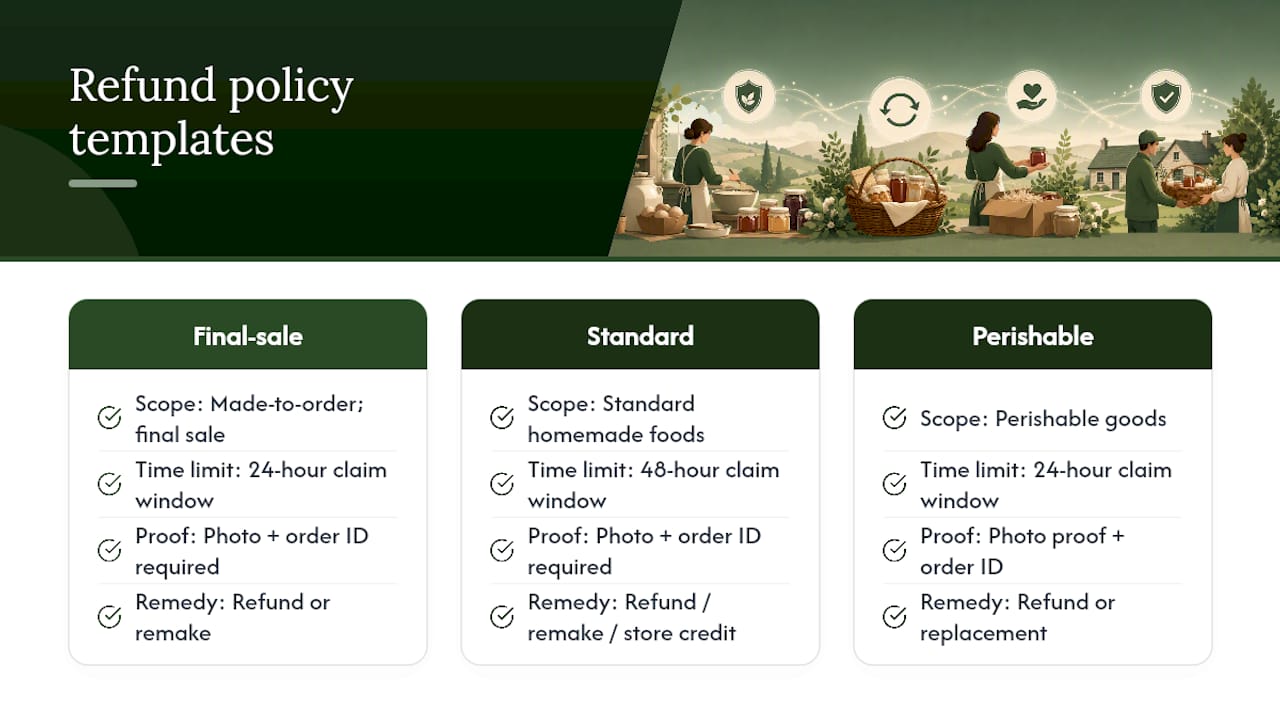
Copy-Ready Refund Policy Templates You Can Use Today
Adapt one of these directly. Keep the language this short on purpose, since a policy a customer can't finish reading in under a minute won't get read at all.
Final-sale template (made-to-order or highly perishable items): "All items are made fresh to order and are final sale. We do not offer refunds for taste or change of mind. If your order arrives damaged, spoiled, or incorrect, contact us within 24 hours with your order ID and a photo, and we'll offer a refund or remake."
Standard homemade food return policy template: "We want you to be happy with your order. Refunds, remakes, or store credit are available if your item arrives defective, is the wrong item, or does not arrive at all. Requests must include your order ID and photo evidence and be submitted within 48 hours of delivery. We do not offer refunds for taste preference or if the item was mishandled after delivery."
Perishable-specific wording: "Because this product is perishable, all sales are final once delivered in good condition. Claims for spoilage or damage must be reported within 24 hours with photo proof. Approved claims will receive a refund or replacement, at our discretion."
Where to Display Your Policy and Prove Customers Saw It
A policy nobody saw isn't a policy, it's a suggestion. Posting location is what turns your written rules into something enforceable.
- Add a checkbox at checkout that customers must click before completing payment, and put the same text directly on the product or order page
- Post a physical sign at your market stall or pickup table, and print a short version on receipts or packaging labels
- Save every order confirmation and every record of a checked consent box for a reasonable period
- Know that payment processors investigating a chargeback will specifically ask for proof the buyer saw the terms before paying, not after
This is also where selling through a platform helps rather than hurts you. Whether you're listing on Etsy or Facebook Marketplace, the same rule applies: your policy needs to live somewhere the buyer had to see before checkout, not somewhere they could have seen if they'd scrolled further.
Harvest Hub's Take on Publishing a Policy That Sticks
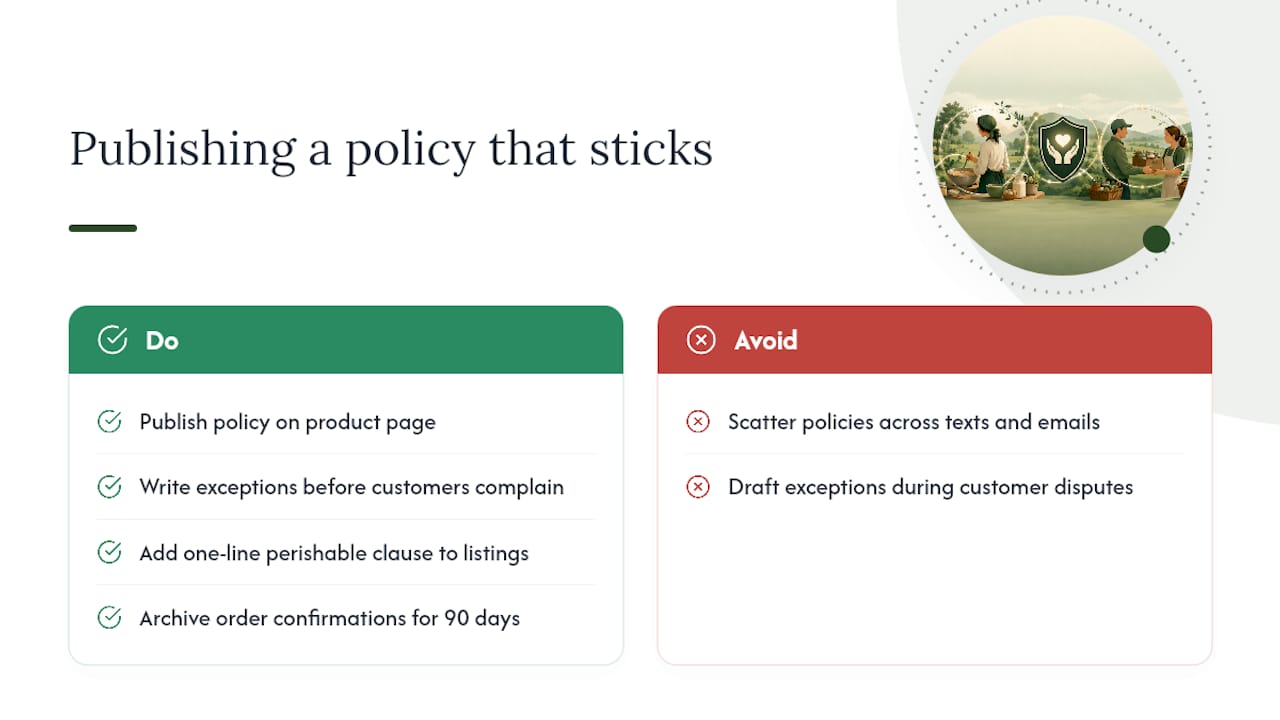
Every seller storefront on a digital farm stand platform can carry policy text directly on the product page, where buyers read product details before ordering. That placement serves both to satisfy conspicuous-disclosure standards and to keep order confirmations and buyer messages archived in one place rather than scattered across texts and emails.
Sheldon, who's spent years advising home bakers on cottage food rules, puts it simply: write your exceptions before you ever need them, not while a customer is already upset. He's seen two recurring patterns hold up well. One vendor who posted a one-line perishable clause on every listing saw complaint calls drop noticeably once buyers knew the rule going in. Another who saved every order confirmation email for 90 days won a chargeback dispute purely because the bank could see the buyer had checked a policy box at checkout.
A Personal Note on Handling These Requests
Here's the honest version: most refund requests aren't attempts to scam you. They're disappointed customers who don't know your rules yet, because you never told them. Give them a script instead of an argument. Something like: "I'm sorry this didn't turn out right. Per our policy, here's what I can offer, a refund, remake, or credit." That single sentence prevents most escalations. Keep photo and order records for everything, and if someone reports an allergic reaction, treat that claim as urgent no matter how the policy reads on paper.
— Sheldon
Let Harvest Hub Handle the Paper Trail for You
Writing the policy is half the job. Keeping the receipts, order confirmations, and buyer messages organized enough to actually use them in a dispute is the other half, and that's the part most home sellers let slide until they need it. A farm stand page on a community marketplace platform gives sellers a permanent spot to post policy text where buyers see it before ordering, plus features like verified profiles and stored order histories that help keep record-keeping organized rather than scattered across texts and screenshots.

You can add your refund terms directly to your listing, keep buyer messages and confirmations archived for as long as you need them, and build the kind of visible, consistent reputation that heads off disputes before they start by following the Terms of Use guidelines. If you're ready to put this into practice, open a farm stand on Harvest Hub and get your policy live where buyers will actually read it.
Where to Check the Legal Details Yourself
State consumer protection rules shift often enough that it's worth verifying your own state's requirements directly rather than relying on a general template. Start with Termly's breakdown of when a no-refund policy actually holds up, then compare your draft against LegalClarity's enforceable policy guidance before you publish anything final-sale.
Sources
- How to Handle Refunds and Returns for Food Products
- No refund policy: when it works and how to post it
- How to write an enforceable no refund policy