
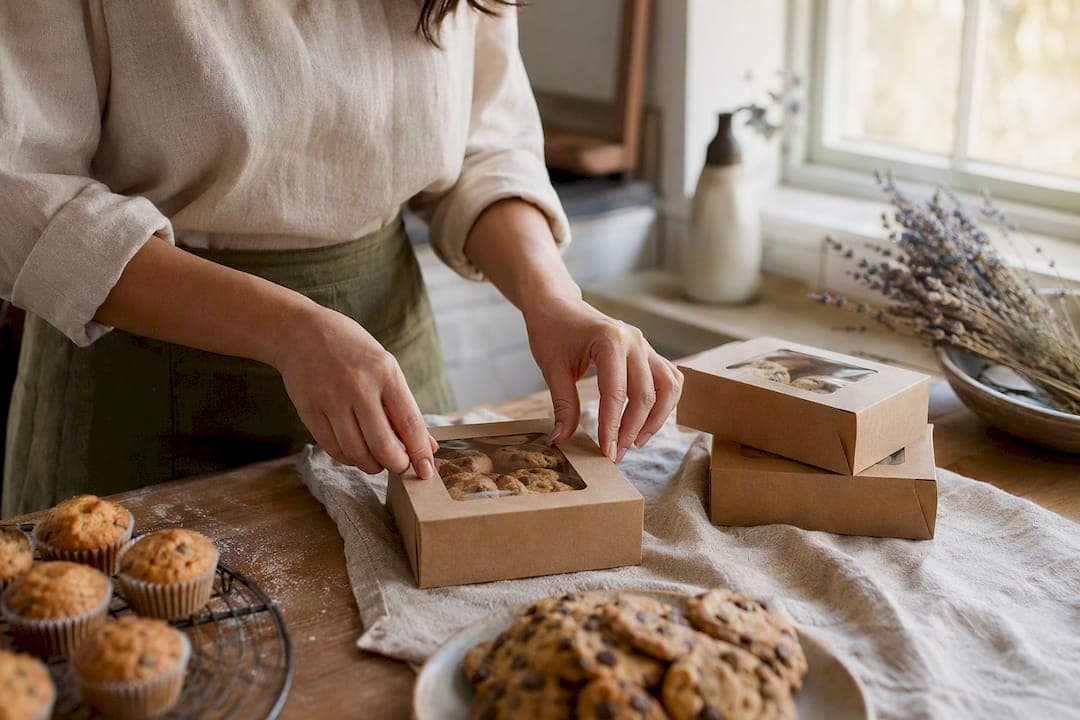
Yes. You can deliver shelf-stable baked goods to local customers under most states' cottage food laws, as long as you check your state's specific rules first. Potentially hazardous items, like cream-filled pastries, generally can't leave your kitchen this way. Here's the fast version:
- Check your state's cottage food rules before you take a single order.
- Set one delivery day and a firm cutoff time, so production stays predictable.
- Take preorders and batch-deliver instead of running one-off trips for every customer.
A ready-made storefront like Harvest Hub handles the preorder list, delivery zones, and payment collection, so you're not juggling text messages and spreadsheets while bread is in the oven.
Key Takeaways
Local delivery of shelf-stable baked goods is allowed under most state cottage food laws, and a batched, preorder-driven route makes it profitable for a single baker to run.
| Point | Details |
|---|---|
| Verify your state's rules first | Sales caps and delivery permissions vary widely by state, with examples ranging from $5,000 to over $250,000 in annual sales. |
| Know your product classification | Shelf-stable items like cookies and bread typically qualify; cream-filled or custard items usually don't. |
| Batch your delivery route | Take preorders, close 48 to 72 hours out, and deliver 10 to 15 stops in one trip. |
| Price with a real formula | Combine round-trip mileage cost with an hourly rate of $15 to $20 to set your delivery fee. |
| Use one storefront link | Harvest Hub lets you publish delivery zones, collect prepayment, and export a sorted production list from a single farm stand page. |
Table of Contents
- How to Ship Baked Goods Locally Under Cottage Food Rules
- Route Delivery, Porch Pickup, or Subscription: Which Should You Run?
- What Should You Charge for Baked Goods Delivery?
- What Features Does Your Ordering Page Actually Need?
- Packaging and Temperature Rules for Baked Goods
- How Do You Plan a Delivery Route Without Losing a Whole Day?
- Do You Need Insurance to Deliver Baked Goods?
- What Federal Rules Apply Beyond Your State's Cottage Food Law?
- How Do You Market Local Baked Goods Delivery?
- Start Your Farm Stand and Automate Delivery Day
- What I'd Tell a Baker Starting Their First Delivery Route
- Frequently Asked Questions
- Sources
How to Ship Baked Goods Locally Under Cottage Food Rules
Cottage food laws are state laws, and they don't agree with each other on much. Some states cap annual gross sales at $5,000; Florida allows up to $250,000 under its cottage food exemption, according to a state-by-state compilation of cottage food statutes. Labeling requirements, allowed sales venues, and whether you can deliver at all instead of requiring pickup all vary the same way.
The product itself matters as much as the state you're in. Regulators split baked goods into shelf-stable items and potentially hazardous foods, often shortened to PHF or TCS (time/temperature control for safety). Cookies, most breads, biscotti, and shelf-stable buttercream frostings typically fall on the safe side. Cream-filled pastries, custard pies, and cream-cheese frostings usually don't, because they need refrigeration to stay safe.
Quick fact: Cottage food sales caps range from around $5,000 to over $250,000 depending on the state, with Florida on the high end of that range.
Before you deliver anything, confirm and document:
- Your state's current sales cap and permitted venues
- Whether third-party couriers are restricted (many states only allow vendor or household-member delivery)
- Required label content: business name and address, ingredients, allergens, and a "Made in a home kitchen" disclosure where mandated
Start with the National Agricultural Law Center's state compilation to find your exact statute.
Route Delivery, Porch Pickup, or Subscription: Which Should You Run?
Pick your delivery model based on how many orders you can realistically handle in one day, not how many you'd like to have.
- Batched route delivery. You take preorders, close them 48 to 72 hours out, bake in one batch, then drive a mapped route. This is the model most solo vendors land on because it turns a dozen scattered requests into one efficient loop, according to a breakdown of one-person delivery operations.
- Porch drop or pickup. Simplest option if you're testing demand or don't want to drive at all. Customers grab orders from a set spot and time window.
- Hybrid. Offer both, but keep them on separate days so your kitchen schedule doesn't collapse.
- Subscription. A standing weekly order (say, a dozen rolls every Friday) gives you predictable revenue and lets you plan flour and butter purchases in advance.
Most vendors start with a 5 to 10 mile radius and one delivery day per week, then expand once that route consistently fills 25 to 30 stops.
Pro Tip: Don't add a second delivery day until your first one is full. A half-empty second route costs you gas and time for nothing.
What Should You Charge for Baked Goods Delivery?
A workable fee formula: (round-trip mileage × your mileage rate) + (drive time × your hourly rate). Many bakers benchmark mileage against the IRS standard rate and value their time at $15 to $20 an hour, based on guidance for cottage bakery delivery pricing.
In practice, that math tends to produce flat fees of $5 to $10 for short local routes, or tiered pricing by zone, say, $5 within three miles and $10 beyond that.
Quick fact: Delivery customers often spend significantly more per order than pickup customers, which is part of why the small fee still pays off.
Write these policies down before your first order goes out:
- Order cutoff time (48 to 72 hours before delivery is standard)
- Cancellation window and refund terms for damaged items
- What happens when no one answers the door (porch drop with photo confirmation is the usual default)
Offer free delivery above a minimum order or a small discount for subscription customers. Both nudge order size up without cutting into your margin much.
What Features Does Your Ordering Page Actually Need?
Your ordering page needs to do four things without you touching it: collect payment upfront, capture a real address, let customers choose delivery or pickup, and enforce your cutoff automatically. A page missing any one of those turns into a text-message fire drill the night before your route.
- Prepayment at checkout, not "I'll Venmo you later"
- Address and delivery-window capture built into the order form
- Automatic cutoff enforcement so late orders can't sneak in
- An exportable, sorted production list you can hand to yourself in the kitchen
A single ordering link matters more than it sounds like it should. Platforms built for this, like Harvest Hub, replace scattered Venmo requests and DM threads with one link, one payment system, and one sorted list by stop, which is what actually makes a solo delivery route manageable at scale. Prefer a flat monthly cost over per-order fees once you're running regular routes. Automate order confirmations and a pre-delivery text so customers know roughly when to expect their bread.
Packaging and Temperature Rules for Baked Goods
Packaging is where good deliveries go bad if you skip it. Kraft bakery boxes work for cookies and bars, rigid boxes protect cupcakes and cakes from getting crushed, and insulated bags matter for anything temperature-sensitive, per packaging guidance for local food delivery. Deliver within two hours of packing whenever you can.
Every package needs a label with your business name and address, ingredients, allergens, a "Made in a home kitchen" disclosure where your state requires it, and the customer's name or order number so nothing gets swapped at the porch. For broader labeling and quality benchmarks beyond the legal minimum, the handmade product quality standards guide is a useful reference for small makers generally.
Load your car with the last stop's order in first, so you're not digging through boxes at every driveway. Stack rigid boxes flat, never on their side, and keep anything delicate off the floor of a hatchback where every bump reaches it.
How Do You Plan a Delivery Route Without Losing a Whole Day?
Run your week in a fixed sequence: open orders, enforce the cutoff, produce in one batch, pack by stop, load in reverse order, deliver, confirm.
- Open your ordering page a week ahead and close it 48 to 72 hours before delivery.
- Bake and pack the same day you deliver whenever your schedule allows.
- Pack each order labeled by stop number, not alphabetically by customer name.
- Load the car in reverse route order, so the first stop's box is on top.
- Deliver, snap a porch photo, and send a quick confirmation text.
- Log sales, mileage, and any missed deliveries before you forget the details.
Ten to fifteen stops is a realistic solo route; anything beyond that starts eating your whole afternoon. Cluster stops by neighborhood before you commit to a route, not by the order customers happened to place.
Pro Tip: Track your actual mileage and time for three weeks before you touch your delivery fee. Guessing at cost is how bakers underprice themselves for months.
For a missed delivery, leave the order in a shaded spot if your policy allows it, text the customer immediately, and have a clear rule for whether they get a redelivery or a refund. Keep a simple log of sales, miles driven, and any complaints. That log is what tells you, three weeks from now, whether your fee actually covers your gas and time.
Do You Need Insurance to Deliver Baked Goods?
Homeowners' and renters' policies generally don't cover a foodborne illness claim, and most cottage food exemptions don't include liability protection. That gap is worth closing before you're driving boxes of cookies to strangers' porches every week.
General liability insurance, and specifically product liability coverage, protects you if a customer claims your food made them sick, even if the claim turns out to be unfounded. Many home-based food producers add a rider to an existing policy or buy a standalone small-business policy through insurers that specialize in home-based food businesses. Costs vary by state and coverage amount, so get a quote rather than assuming it's out of reach.
Delivery itself adds a second layer worth thinking through. If you're driving your personal vehicle for business deliveries, check whether your auto policy excludes commercial use, some do, and a rideshare-style endorsement or commercial rider can close that gap cheaply.
Document everything: keep dated photos of your packaging and labels, save your recipe and allergen lists, and keep a record of every order and delivery confirmation. If a dispute ever comes up, that paper trail is your first line of defense, well before you'd need to lean on insurance at all.
None of this is legal advice, and coverage requirements differ by state and by insurer. Talk to an agent familiar with home-based food businesses before you scale past casual neighbor sales.
What Federal Rules Apply Beyond Your State's Cottage Food Law?
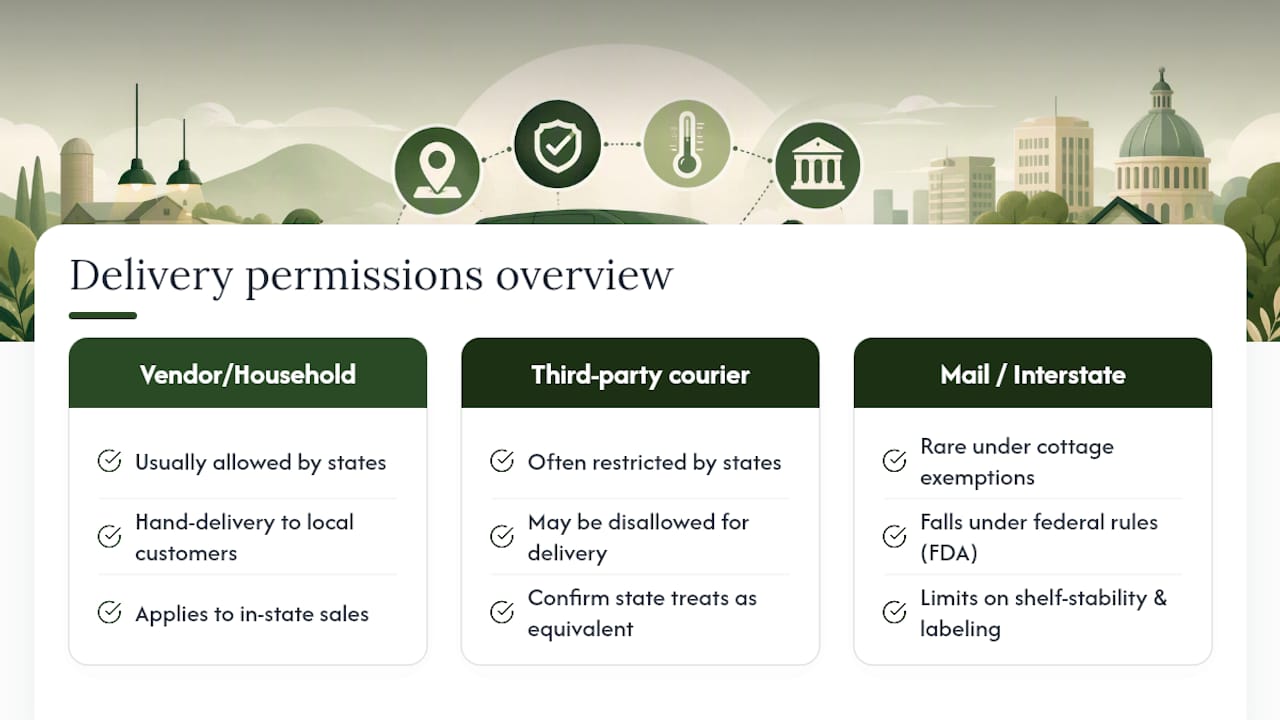
Cottage food exemptions are state law, but they don't erase federal food safety rules entirely. The FDA still has jurisdiction over food safety broadly, and cottage food exemptions typically apply only to direct sales within your state, not across state lines.
That distinction matters for delivery specifically. Most states permit you, the vendor, or a household member to hand-deliver cottage food products directly to local customers. Fewer states extend that permission to third-party couriers or delivery services, and some restrict which sales venues (farmers markets, roadside stands, direct delivery) are allowed at all, according to the breakdown of local delivery rules for solo vendors. Before you hire a driver or partner with a courier app, confirm your state treats that as equivalent to vendor delivery.
Online sales complicate things further. Most states allow online sales to in-state buyers, and a smaller number allow some form of mail delivery, but "some form" usually comes with real restrictions on shelf-stability, labeling, or distance. This is exactly why this guide focuses on local, in-state delivery: it's the model with the fewest gray areas and the one most cottage food laws were actually written to support. If a customer outside your delivery radius asks for their order mailed, that's a different regulatory conversation entirely, one involving interstate commerce rules your cottage food exemption almost certainly doesn't cover.
When in doubt, your state's department of agriculture or health department cottage food program is the authority to call, not a forum post or a competitor's FAQ page.
How Do You Market Local Baked Goods Delivery?
Your existing customers are your fastest growth channel. Every porch drop is a small advertisement, so a branded sticker or a simple thank-you card with your ordering link turns a one-time buyer into someone who reorders without being asked.
Neighborhood-specific promotion beats broad social posts for a local delivery business. Post in local community groups, mention your delivery radius explicitly, and lead with your delivery day so people can picture ordering before their next weekend plans get set. A referral nudge, "$5 off when a neighbor orders too", works especially well for delivery specifically, since your existing customers already know people on the same streets you're driving.
Bundle promotions around your cutoff time. A "last call for Friday delivery" reminder two days before your cutoff creates urgency without discounting anything. Subscription customers are worth highlighting publicly too: a standing weekly order from a happy customer is social proof that your delivery is reliable, not a one-off.
Cross-promote with other local producers if you're on a shared marketplace. A jam maker's customers are often your customers too, and a joint delivery day or bundled order expands both your reach without extra ad spend. Consistency matters more than volume here: a baker who delivers every Friday, rain or shine, for six months builds more trust in a neighborhood than one who posts constantly but ships on and off.
Start Your Farm Stand and Automate Delivery Day
Harvest Hub gives you the one thing most home bakers cobble together badly: a single link that handles preorders, payment, and your delivery zones without a spreadsheet.
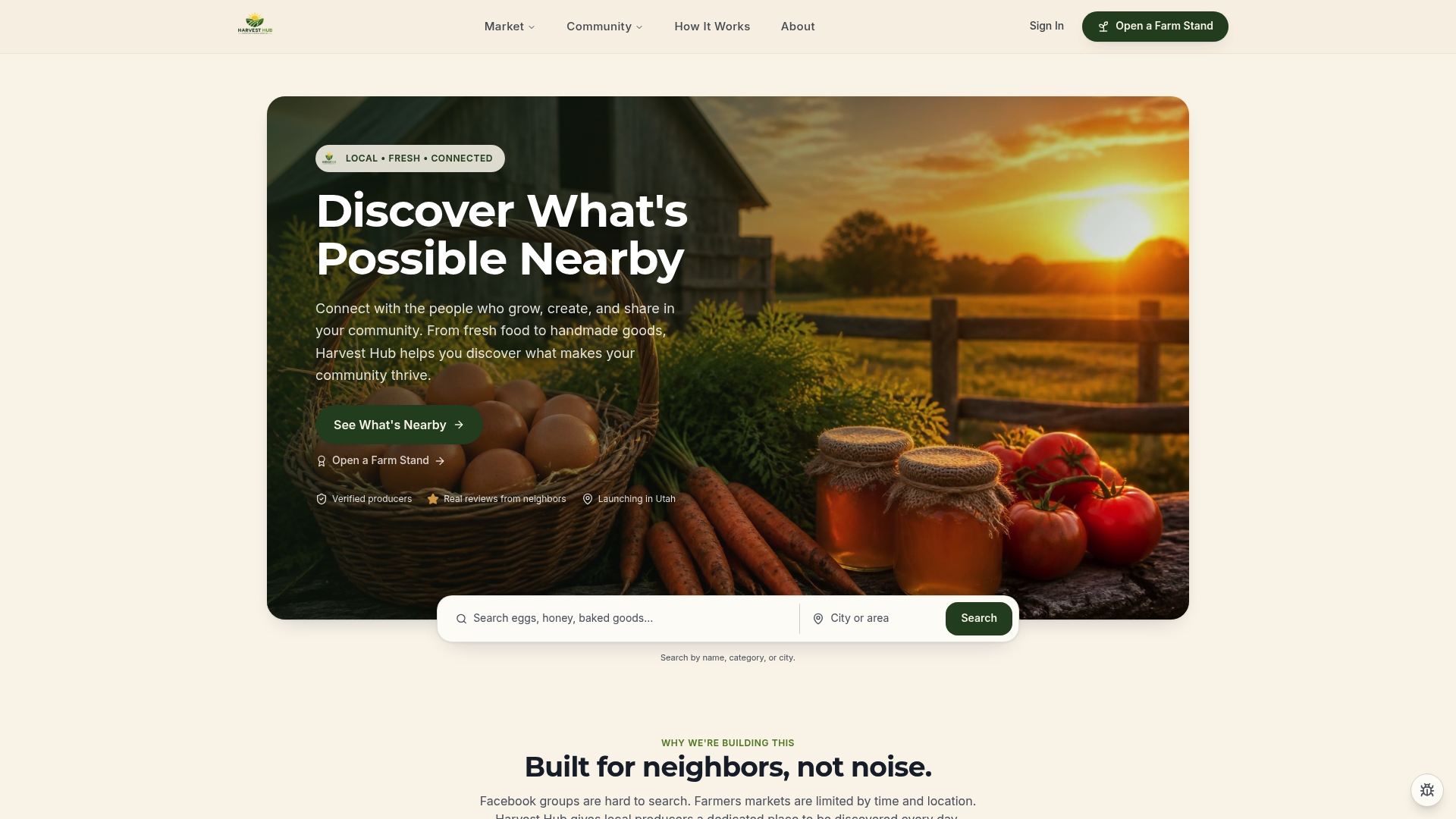
You already know the workflow from this guide, open orders, enforce a cutoff, batch-produce, pack by stop, deliver a route. Harvest Hub is built around exactly that sequence. You set up a digital farm stand, list your shelf-stable items, publish your delivery zone and cutoff time, and the platform collects payment and hands you a sorted production list instead of a pile of text messages the night before. That's the real advantage over running delivery through Venmo requests and group chats: one link replaces five different tools.
To get started, open a farm stand, add your baked goods with clear labels and pricing, set your delivery day and cutoff, and promote the link to your neighborhood. You can see what a real listing looks like on profiles like Moon Farms Country Market or FarmBox SF. If you want to unlock premium storefront features, unlimited listings, and analytics on your delivery route, check the pricing page for producer plans.
What I'd Tell a Baker Starting Their First Delivery Route
The bakers who make delivery work don't start big. They pick one tight radius, one delivery day, and they say no to everything outside it for the first month. That restraint is the actual skill here, not the baking.
Enforce your cutoff and require prepayment from day one, even when a regular customer asks for an exception. The first exception becomes the expectation, and now you're baking off-schedule for one person while everyone else's order sits half-finished. Track your mileage, your time, and your actual costs for three full weeks before you touch your pricing. Most new delivery bakers underprice because they guessed at their gas cost instead of logging it.
If you're starting today: verify your state's cottage food rules, set your delivery page and cutoff time, then run one real route and ask every customer what almost stopped them from ordering. That answer will tell you more about your pricing and packaging than any amount of planning will.
Frequently Asked Questions
Can you ship baked goods across state lines under cottage food law? No. Cottage food exemptions generally cover in-state sales only. Shipping baked goods to another state involves federal food safety rules your state cottage food exemption doesn't cover.
Can you ship cottage food items using a third-party delivery service? It depends on your state. Many states only permit direct delivery by the vendor or a household member, so check your state's rules before hiring a courier or delivery app.
How do you ship cookies locally without them arriving broken? Use a rigid kraft bakery box, avoid stacking anything heavy on top, load the box flat in your car, and deliver within about two hours of packing whenever possible.
What's the difference between baked goods delivery options like pickup, route delivery, and subscription? Pickup asks customers to come to you, route delivery batches preorders into one mapped trip, and subscriptions lock in a standing weekly order. Most solo bakers start with route delivery on a single day.
Do you need a special license to deliver fresh pastries locally? Most states let you operate under a cottage food registration or permit rather than a full commercial license, but requirements vary. Confirm your state's specific threshold before you start taking orders.