
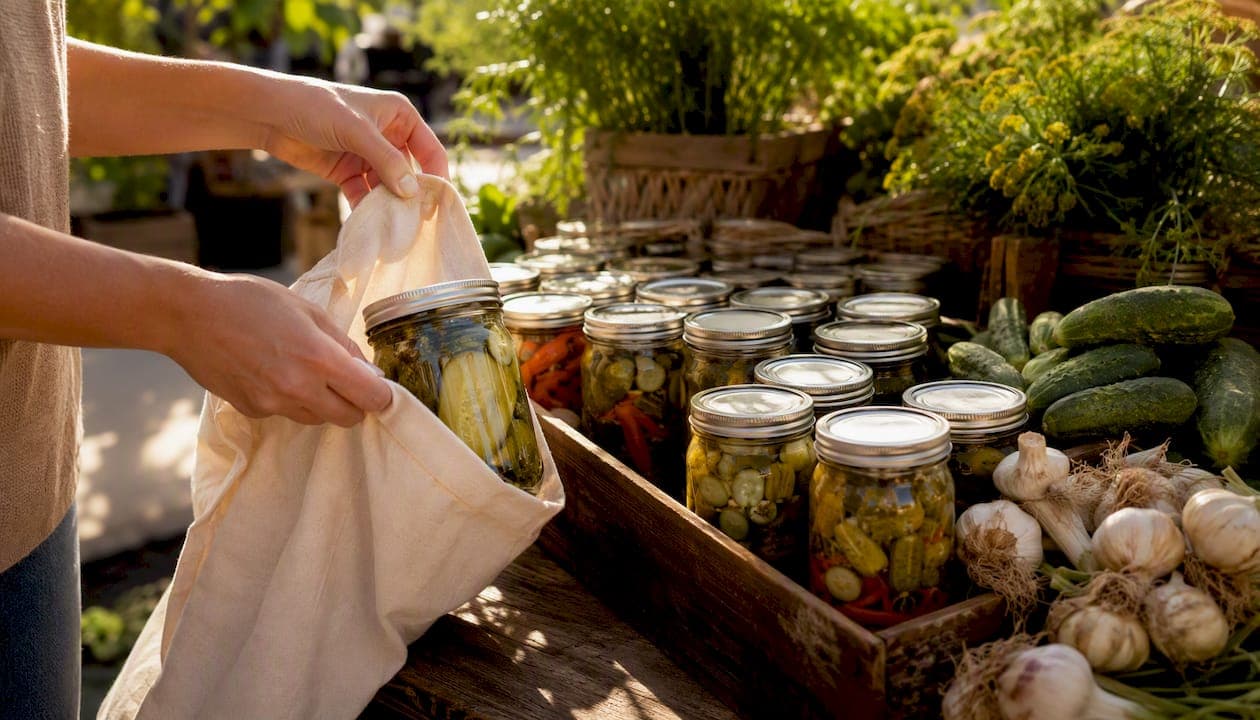
Yes, you can sell pickles online — and the fastest safe path is a local-first preorder and pickup model, starting with a platform like Harvesthub before you ever pack a jar for shipping. The reason is simple: local sales sidestep the most expensive legal and logistical hurdles that stop new sellers cold.
Before you list a single jar, three things need a quick check:
- Legal: Most U.S. states allow acidified pickles under cottage food laws, but sales limits, permitted venues, and labeling rules vary sharply by state. Confirm yours before you take money.
- Safety: Vinegar-based pickles must hit a pH below 4.6 to be shelf-stable and safe. Test before you sell, not after.
- Platform: Open a digital farm stand on Harvesthub to accept preorders and coordinate local pickup — no shipping required to make your first sale.
Key Takeaways
Selling pickles online works best when you start local, get your safety documentation right, and use a platform built for direct-to-consumer food sales.
| Point | Details |
|---|---|
| Start local, not national | Local preorder and pickup eliminates shipping costs and most legal complications for new sellers. |
| pH below 4.6 is non-negotiable | Test every batch with a calibrated meter; use NCHFP-tested recipes or get a process authority review. |
| Check your state cottage food law | Sales caps, permitted venues, and shipping rules vary by state — verify before you list. |
| Price at 3x total cost | Include ingredients, jars, labels, labor, and overhead in your cost model before setting a retail price. |
| Harvesthub for local discovery | Open a digital farm stand on Harvesthub to list products, coordinate pickup, and build verified reviews locally. |
Table of Contents
- How to sell pickles online: why local-first preorders are the smartest starting point
- Can I legally sell homemade pickles? State cottage food rules, permits, and labeling
- Food safety, acidification, pH testing, and realistic shelf life
- Packaging and shipping: jars, leak prevention, and when it makes sense
- How to price jars, plan batches, and keep your pickle business profitable
- Step-by-step: create listings, accept orders, and run fulfillment
- How to find buyers: the most effective marketing channels for selling pickles online
- Common mistakes, risks, and red flags to avoid when selling pickles online
- The case for starting local before you think about scale
- Your digital farm stand is already waiting on Harvesthub
- Sources
How to sell pickles online: why local-first preorders are the smartest starting point
The instinct for most new pickle sellers is to list on a national marketplace and ship everywhere. That instinct is expensive. A single 16-ounce glass jar can weigh over a pound before packaging, and once you add cushioning, a box, and insurance, the shipping cost often exceeds the jar's retail price. That math kills margins before you've built a customer base.
Local-first preorder and pickup flips the model. You list your products online, collect orders in advance, and hand jars directly to buyers at a scheduled pickup window or farmers market. No carrier fees, no leak risk, no interstate commerce complications. Sellers who build this way often reach profitability on their first batch run.
Local pickup vs. shipping vs. wholesale: a quick comparison
Local pickup/preorders give you the lowest cost-to-serve, the fewest legal hurdles, and direct customer feedback. Most cottage food laws explicitly permit direct-to-consumer sales at home, farmers markets, or community events. You collect payment online, confirm the order, and hand it off in person.
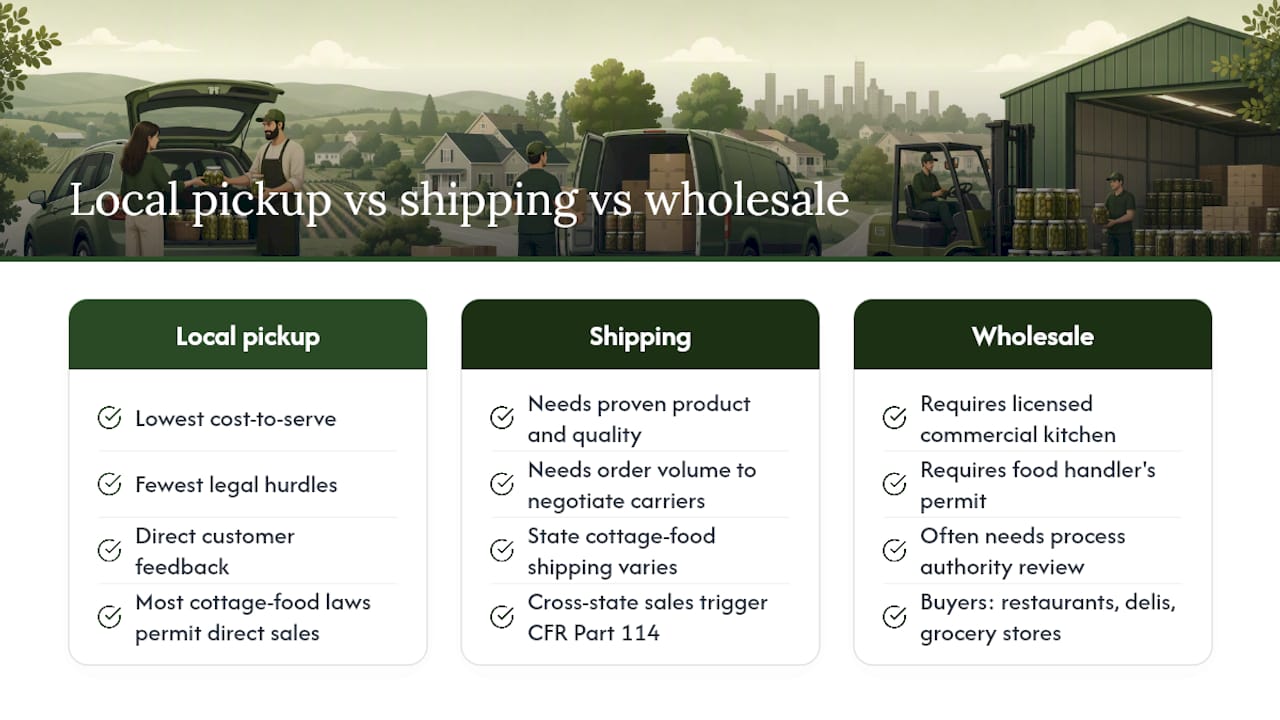
Shipping makes sense once you have a proven product, consistent batch quality, and enough order volume to negotiate carrier rates. It also requires you to understand whether your state's cottage food law permits intrastate shipping (some do, some don't) and whether crossing state lines triggers FDA acidified foods regulations under CFR Part 114.
Wholesale (supplying restaurants, delis, or grocery stores) typically requires a licensed commercial kitchen, a food handler's permit, and in many cases a process authority review. It's a viable growth path, not a starting point.
Why Harvesthub fits the local-first model
Harvesthub is built exactly for this kind of seller. You create a digital farm stand, list your pickle varieties with photos and batch details, and buyers in your area find you through category browsing and map search. The platform supports verified profiles and real reviews, which matters when you're asking a neighbor to trust a home-made food product. Sellers like those at Uncle Johnny's UPick Farm use this same model to list seasonal products and coordinate pickup without a dedicated e-commerce site.
Before you list: a quick-prep checklist
- Photograph your jars in natural light with labels clearly visible
- Write out your full ingredient list and check for the top 9 allergens (wheat, milk, eggs, fish, shellfish, tree nuts, peanuts, sesame, soybeans)
- Record your batch date, yield count, and pH test result for every run
- Set your price per jar and per bundle before you open the listing
- Draft your pickup window and location details so buyers know exactly what to expect
When to consider scaling beyond local: Once you're selling out within 48 hours of posting, have at least 20 repeat buyers, and your state cottage food law permits intrastate shipping, it's worth testing a small shipping pilot with bundled orders of three or more jars.
Can I legally sell homemade pickles? State cottage food rules, permits, and labeling
The short answer is yes in most states, but the details matter enough that you should verify your specific state's rules before accepting a single dollar.
Most U.S. states allow home picklers to sell acidified or vinegar-based pickles under cottage food laws. These laws typically set annual gross sales caps, restrict sales to direct-to-consumer venues, and require specific label language. A few states are more permissive. Florida's cottage food guidance, for example, allows certain online sales and intrastate shipping, while other states limit you to in-person transactions only. North Carolina's cottage food page shows how state rules define eligible product categories and permitted venues — a useful model for understanding what to look for on your own state's agriculture department site.
When you need more than a cottage food exemption
Some products and some ambitions push past what cottage food laws cover. You'll likely need a licensed commercial kitchen or additional permits if:
- Your annual sales approach or exceed your state's cottage food revenue cap
- You want to sell wholesale to retailers or restaurants
- You plan to ship across state lines (which can trigger federal oversight under FDA CFR Part 114)
- Your state classifies naturally fermented pickles differently from vinegar-based ones (some do)
Michigan's cottage food law, for instance, specifies labeling requirements and venue restrictions that differ from neighboring states. Never assume one state's rules apply to another.
Required label elements: a checklist
Every jar you sell should carry these elements at minimum:
- Product name (e.g., "Bread and Butter Pickles")
- Full ingredient list in descending order by weight
- Net weight in both ounces and grams
- Allergen declaration for any of the top 9 allergens present
- Business name and contact information (city and state at minimum)
- Best-by or use-by date
- Cottage food disclaimer where required by state law (common language: "Made in a home kitchen not inspected by the [State] Department of Agriculture")
State-by-state action checklist
To confirm your compliance, look up these specifics on your state's Department of Agriculture or Department of Health website:
- Is your product category (acidified pickles, fermented pickles) explicitly allowed under cottage food?
- What is the annual gross sales cap?
- Are online orders and/or intrastate shipping permitted?
- What label disclaimer language does your state require?
- Do you need a food handler's permit or home kitchen inspection?
Food safety, acidification, pH testing, and realistic shelf life
Safe pickles are not just a legal requirement. They're the foundation of a business that earns repeat customers instead of refund requests.
Acidified vs. fermented pickles: why the distinction matters
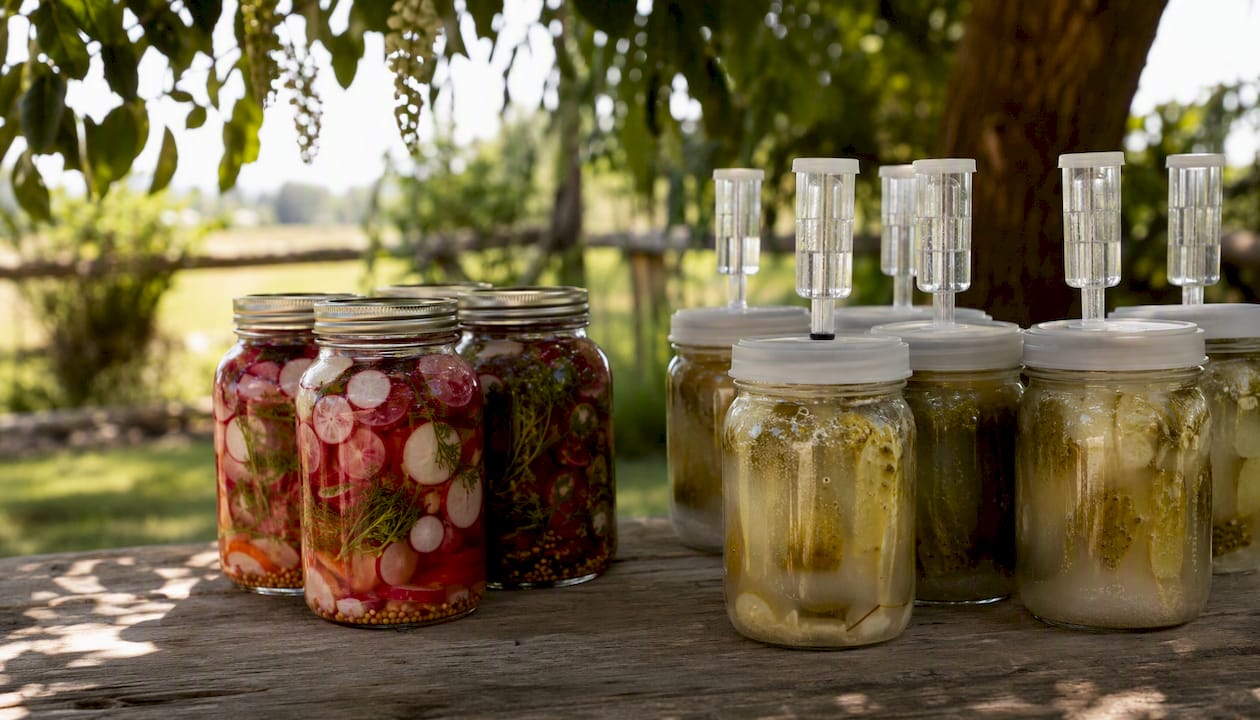
NCHFP's pickled products guidance draws a clear line between two types. Acidified pickles use vinegar to drop pH quickly and create a shelf-stable product. Fermented pickles (like traditional dill crocks) rely on lactic acid bacteria to lower pH over days or weeks. Both can be safe, but they require different processes, different documentation, and in some states, different regulatory treatment.
For new sellers, vinegar-based pickles are the more predictable starting point. The NCHFP's general pickling guidance specifies that safe acidification depends on tested processes, including proper vinegar concentration (at least 5% acidity) and correct processing methods. Deviating from tested recipes — diluting vinegar, adding extra water, or skipping a water-bath step — can push pH above the safe threshold without any visible sign.
Why pH below 4.6 is the number that matters
A pH of 4.6 is the threshold below which Clostridium botulinum cannot produce toxin. Shelf-stable pickles must stay below this level throughout their shelf life, not just at the moment of packing. A calibrated pH meter (not strips, which lack the precision needed for food safety documentation) is a worthwhile investment before your first sale.
For sellers who want lab verification or need a process authority review, CPI at New Mexico State University offers technical resources and testing support specifically for small food processors. A process authority review is required under FDA CFR Part 114 for acidified foods sold in interstate commerce, and it's good practice even for local sales.
Documenting safety and setting shelf life
Keep a batch log for every production run. Record the date, recipe version, vinegar brand and acidity percentage, pH reading (pre- and post-processing), yield count, and any deviations from the standard recipe. Store these records for at least two years. If a customer ever reports a problem, this log is your first line of defense.
Realistic shelf life for properly acidified, water-bath-processed pickles is generally several months unopened when stored in a cool, dark place. Label your jars with a best-by date that reflects this conservatively. Once opened, refrigeration and a few weeks' use window is standard guidance.
Pro Tip: Number each batch sequentially and write the batch number on the jar lid with a paint marker before labeling. If you ever need to recall a run, you can identify affected jars instantly without pulling every jar off a shelf.
Packaging and shipping: jars, leak prevention, and when it makes sense
Shipping pickles is a solvable problem, but it's not a cheap one. Glass is heavy, brine leaks, and carriers are not gentle. Most home picklers who try to ship single jars without a packaging system in place lose money on their first few orders.
Jar and lid choices
Wide-mouth mason jars (Ball or Kerr) are the standard for home picklers and for good reason: they're widely available, compatible with water-bath canning lids, and buyers recognize them as trustworthy. For shipping, add an induction liner or tamper-evident shrink band over the lid to give buyers visible proof the seal hasn't been broken. Place your label on the body of the jar, not the lid, so it survives handling.
Secondary packaging: preventing leaks in transit
A jar that passes a drop test on your kitchen counter will not necessarily survive a UPS sorting facility. Use these layers:
- Foam jar sleeves or bubble wrap around each jar (at least two layers)
- Absorbent pads at the bottom of the box to contain any brine if a seal fails
- Dividers or cardboard inserts between jars in multi-jar shipments
- Double-boxing for orders of four or more jars: pack jars in an inner box, then place that inside a larger outer box with at least two inches of cushioning on all sides
Shipping realities and when it's viable
| Factor | Local pickup | Shipping (1–2 jars) | Shipping (3+ jar bundle) |
|---|---|---|---|
| Carrier cost | Usually none | Shipping costs can be high | Shipping per jar cost decreases with bundles |
| Breakage/leak risk | Very low | Moderate | Lower per jar |
| Packaging materials | Minimal | Added cost per order | Added cost per order |
| Viable margin | Yes | Often challenging | Possible with right pricing |
Bundling is the lever that makes shipping economics work. A three-jar bundle spreads the fixed packaging and carrier cost across more product, which is why practical guides for pickle sellers consistently recommend leading with multi-jar offers rather than single-jar listings when shipping.
Pre-ship packing checklist
- Induction liner or shrink band applied and intact
- Label affixed to jar body, not lid
- Jar wrapped in at least two layers of cushioning
- Absorbent pad in box bottom
- Box sealed with pressure-sensitive tape on all seams
- Fragile label on exterior (carriers ignore these, but it helps with claims)
- Shipping insurance purchased for orders over $30
How to price jars, plan batches, and keep your pickle business profitable
Pricing pickles without a cost model is how sellers end up making $4 an hour. The math is straightforward once you lay it out.
Unit economics framework
For each jar, add up:
- Ingredient cost (cucumbers, vinegar, spices, garlic, dill — priced per jar based on batch yield)
- Jar and lid cost (typically $1.00–$1.50 per unit when buying in case quantities)
- Label cost (printed labels run $0.10–$0.30 each depending on quantity and method)
- Labor (your time at a rate you set — don't skip this line)
- Overhead (water, electricity, kitchen supplies, platform subscription)
- Shipping allowance (if applicable — build this into the listed price, not as a surprise at checkout)
If your fully loaded cost per jar is $3.50, a retail price of $8.50–$10.50 is defensible and competitive with specialty pickle brands at farmers markets.
Sample pricing framework
Batch planning and scheduling
Match your batch size to your realistic sales window. If you can sell 24 jars in two weeks through local pickup and a Harvesthub listing, run 24-jar batches. Running 60 jars when you can only move 24 means jars sit past their best-by date, which erodes quality and customer trust.
For repeat buyers, a simple subscription or standing order works well. Offer a monthly "pickle club" where subscribers get two jars delivered or available for pickup each month at a slight discount. This stabilizes your production schedule and gives you predictable demand before you start a batch.
Step-by-step: create listings, accept orders, and run fulfillment
Getting the listing right is where most new sellers leave money on the table. A photo of a jar on a white counter with no context does not sell pickles. A photo of an open jar next to a sandwich, with a description that makes the reader taste the brine, does.
Writing a listing that converts
Your product listing needs:
- A descriptive name that includes the style and flavor profile ("Spicy Garlic Dill Pickles — Half Sour, Crunchy")
- Sensory copy in the description: crunch level, brine flavor, heat level, what they pair well with
- Ingredient list and allergen callout — buyers with food sensitivities will look for this before anything else
- Batch date and best-by date
- Net weight and jar size
- Clear pickup or shipping instructions — when, where, and what the buyer needs to bring or do
Order flow from listing to handoff
- Buyer places order and pays through the platform
- You receive notification and confirm availability (reply within 24 hours)
- Pack the order the day before pickup or ship date
- Send the buyer a confirmation with pickup window details or tracking number
- At pickup, verify the order against the packing slip and hand off
- Follow up 48 hours later with a short message asking for a review
Fulfillment tools worth using
For local pickup coordination, Harvesthub's built-in messaging and event tools handle most of what you need. For shipping labels, services like Pirateship offer discounted USPS and UPS rates without a monthly fee. For receipts and order records, a simple Google Sheet or a lightweight invoicing tool like Wave covers the basics at no cost.
Pro Tip: Set a firm pickup window (e.g., Saturdays 10 AM–12 PM) rather than offering open-ended pickup. Buyers show up more reliably, and you batch your handoffs into one efficient block instead of fielding texts all week.
How to find buyers: the most effective marketing channels for selling pickles online
The sellers who build the fastest customer base combine physical presence with a digital listing. Neither alone is as effective as both together.
Channel priorities for pickle sellers
- Farmers markets and local events — sampling converts browsers into buyers faster than any digital channel. One small cup of pickle brine at a market booth can sell a dozen jars in an afternoon.
- Harvesthub listing — your digital farm stand stays open every day, not just on market Saturdays. Buyers who discover you at a market can find you online and place preorders between events.
- Instagram and Facebook — short videos of the canning process, jar reveals, and recipe pairings perform well for food products. Post batch announcements 48 hours before pickup windows to create urgency.
- Email list — even a list of 50 local buyers is worth more than 500 social followers. A simple monthly email announcing new batches, flavors, and pickup dates drives consistent reorders.
- Local press and food bloggers — a single mention in a local food newsletter or a community Facebook group can generate more orders than a week of social posting.
Subscription and bundling tactics
A pickle subscription service does not need to be complicated. A standing monthly order of two or three jars, confirmed by email and paid in advance, gives you predictable revenue and locks in repeat buyers before you've even started the batch.
Bundling works similarly. A "Pickle Sampler" of three different varieties at a slight discount moves more product per transaction and introduces buyers to flavors they might reorder individually. Local sellers who build this way consistently report that repeat customers come from variety exposure, not just from the first jar they tried.
Tracking early marketing ROI
Ask every new buyer how they found you. Keep a simple tally. After 10–15 sales, you'll know whether your Harvesthub listing, your market booth, or your Instagram posts are driving the most orders. Put more energy into the channel that's working and cut the one that isn't.
Common mistakes, risks, and red flags to avoid when selling pickles online
Most pickle business failures are preventable. They cluster around the same handful of mistakes.
Top food safety and legal risks
- Skipping pH testing — assuming a recipe is safe because it "looks right" is not a safety process. Test every batch with a calibrated meter.
- Using untested or modified recipes — adding extra water or reducing vinegar to taste can push pH above 4.6 without any visible sign. Stick to NCHFP-tested recipes or get a process authority review for custom formulations.
- Mislabeling — missing allergen declarations or omitting the required cottage food disclaimer can result in regulatory action even if the product itself is safe.
- Ignoring state sales limits — exceeding your state's annual cottage food revenue cap without upgrading to a licensed kitchen puts your entire operation at risk.
- No batch records — if a customer reports illness and you have no documentation, you have no defense and no way to identify the affected batch.
Operational red flags
- Single-jar shipping orders — if your average order is one jar and you're shipping, you're likely losing money on every transaction. Push bundles before you open shipping.
- Inconsistent yield — if your batch size swings by 30% from run to run, your cost model is unreliable. Standardize your recipe and equipment before scaling.
- No pickup window structure — open-ended pickup arrangements create scheduling chaos. Set fixed windows and stick to them.
Quick remediation steps
- If you haven't pH-tested: buy a calibrated meter this week and test your last batch before the next sale.
- If your labels are incomplete: download your state's cottage food label checklist and compare it against your current label before your next market.
- If shipping is losing money: pause single-jar shipping and relaunch with a three-jar minimum bundle.
The case for starting local before you think about scale
The conventional advice for selling food online pushes sellers toward national platforms and wide distribution from day one. That advice is wrong for most home picklers, and the reason comes down to feedback loops.
When you sell locally, you hand a jar to a neighbor and hear what they think within a week. You learn that your bread-and-butter pickles are too sweet for most palates, or that your spicy garlic variety sells out while the plain dill sits. That feedback is free and immediate. When you ship to strangers across the country, feedback arrives as a review three weeks later, after you've already run two more batches of the same formula.
Local preorders also build something that no shipping model can replicate quickly: trust. A verified profile on Harvesthub with real reviews from real neighbors carries more weight with a new buyer than a polished product page on a national marketplace. The Elderberry Edibles CSA profile on Harvesthub shows how producers who list specialty items and build a local following create the kind of repeat-buyer base that makes a food business sustainable.
The sellers who scale successfully to shipping almost always started local. They used the local phase to nail their recipe, their label, their batch consistency, and their pricing. By the time they started shipping, they had a product worth shipping and customers willing to pay for it.
Your digital farm stand is already waiting on Harvesthub
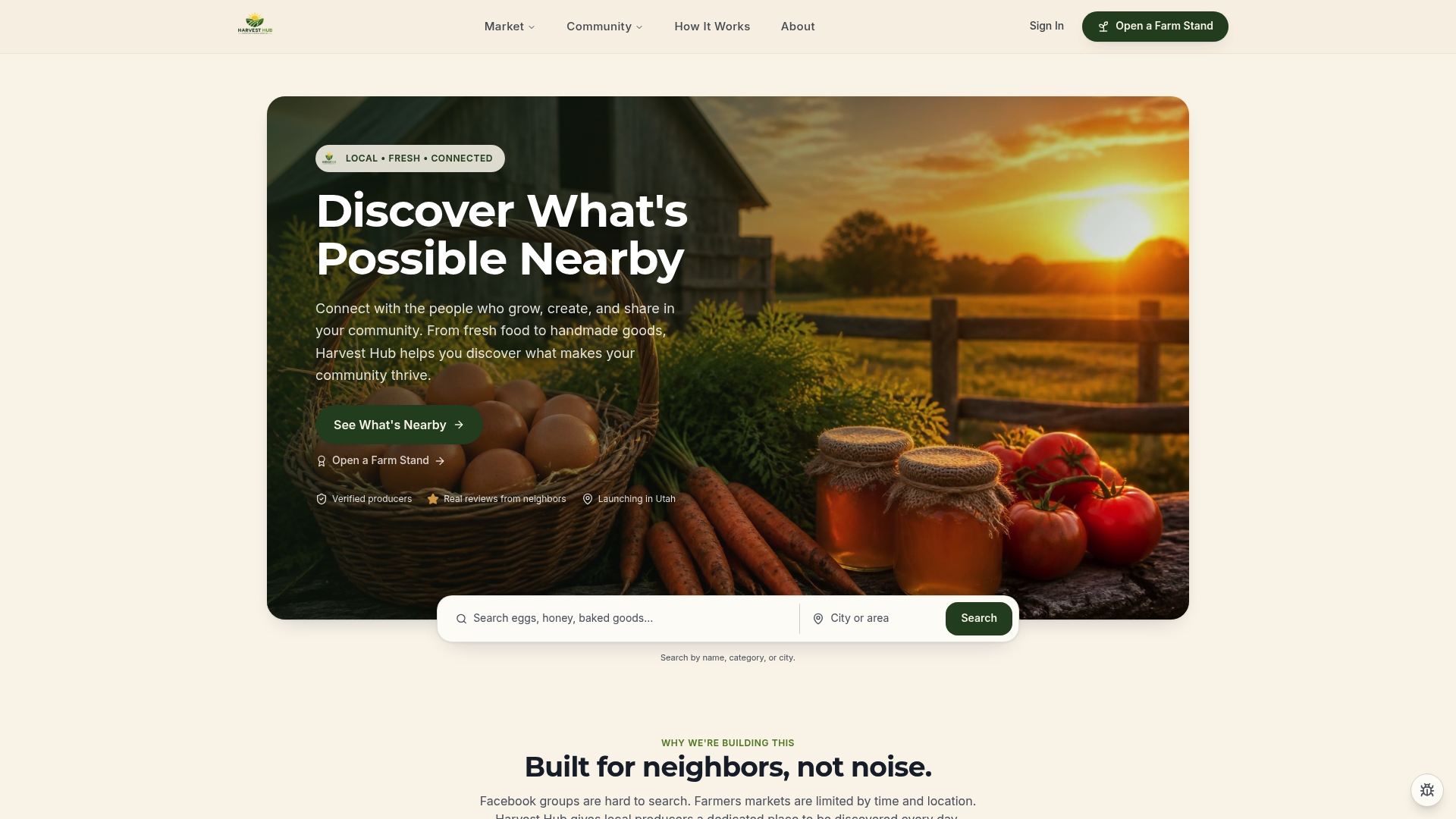
Harvesthub is built for exactly the local-first model this guide recommends. You get a verified digital farm stand, visible to buyers in your area through map search and category browsing, open every day of the year. Buyers can follow your stand, leave reviews, and place preorders for pickup — no shipping required to make your first sale. Real producer profiles like Moon Farms Country Market show how local sellers list products, coordinate pickup windows, and build a loyal neighborhood customer base through the platform.
For pickle sellers specifically, the combination of a verified profile, event discovery tools, and built-in buyer messaging covers everything you need to run a local preorder operation without a separate website or checkout system. Open your farm stand on Harvesthub and have your first listing live before your next batch comes out of the water bath.
Sources
Use these official and extension resources to confirm compliance before your first sale. Rules change, and a state agriculture page updated last month is always more reliable than a general guide written two years ago.
This article provides general information about selling food products online and does not constitute legal, regulatory, or food-safety advice. Confirm current rules with your state's Department of Agriculture, a licensed food safety professional, or a qualified attorney before selling.
This article is general information, not a substitute for advice from a qualified lawyer. Consult a qualified legal professional about your own circumstances before acting on anything here.