
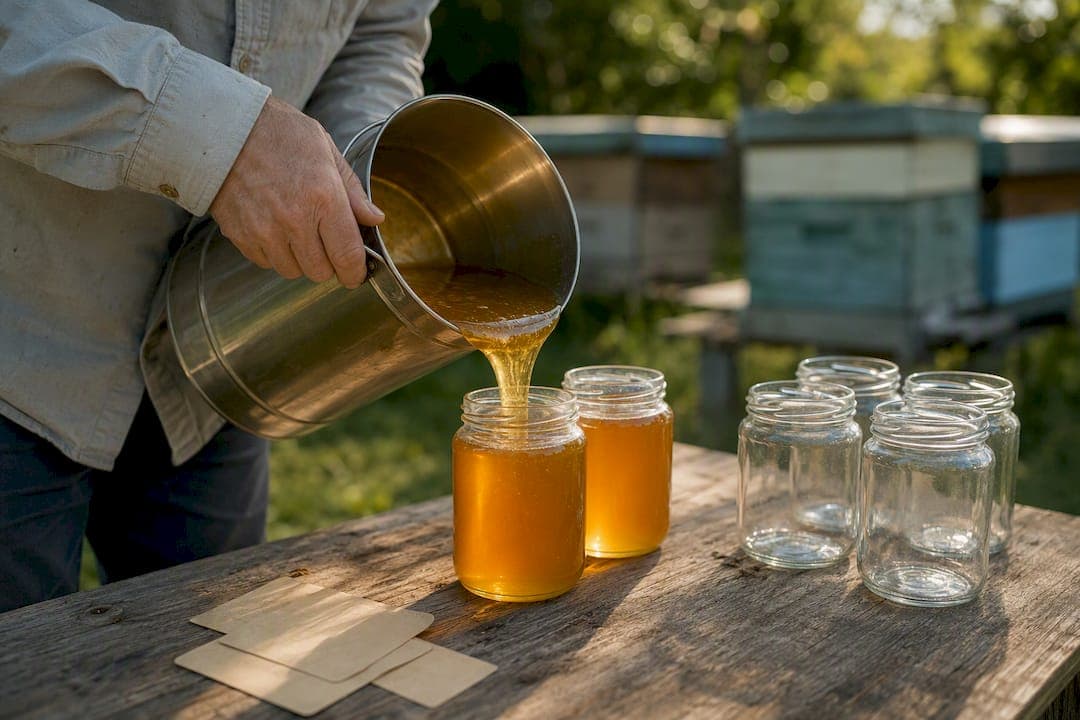
Yes, you can sell honey direct, and most hobby beekeepers can do it with far less paperwork than they assume. The fastest legal path runs through your state's cottage-food law or a dedicated raw-agricultural-product exemption for honey, both of which typically let you skip a commercial kitchen license entirely. Direct sales channels like farmers markets, roadside stands, and local pre-orders also pay better than wholesale, because you keep the full retail markup instead of splitting it with a distributor.
Three things get you selling this season:
- Confirm your state's rules (search "[state name] cottage food" or check your state Department of Agriculture site for honey-specific exemptions).
- Build a compliant label with product name, net weight, and your name or apiary address.
- Pick one selling channel to start (a farmers market table, a farm-stand cooler, or a free listing on a platform like Harvest Hub).
Retail honey typically runs $10 to $18 per jar for a standard 12-ounce size, depending on region and packaging. A few dozen jars from a single harvest can cover your equipment costs for the year.
Key Takeaways
Selling honey direct is legal for most small beekeepers under cottage-food or raw-agricultural exemptions, and pairing an in-person channel with a simple online listing produces steadier income than either alone.
| Point | Details |
|---|---|
| Check your state's rules first | Look up your state's cottage-food cap and any honey-specific exemption before you sell a single jar. |
| Label before you sell | Include product name, net weight in oz and g, and your producer name and address on every jar. |
| Start with one channel | A farmers market or on-farm stand builds trust fastest and keeps full retail margin. |
| Price with real numbers | A 12-ounce jar at $10 to $18 typically leaves $8 to $10 in margin after jar, label, and fees. |
| Use pre-orders for limited harvests | Deposits and a closing window prevent running out mid-season and waste less honey. |
| Add a digital farm stand | A free listing on Harvest Hub lets regulars reorder between market days without a group text. |
Table of Contents
- How to Sell Honey Direct Without a Full Food License
- What Has to Be on Your Honey Label
- Where Should You Sell Honey Direct?
- How Should You Price a Jar of Honey?
- Processing and Storage: What Keeps You Compliant
- Managing Orders, Payments, and Seasonal Supply
- Setting Up a Digital Farm Stand for Honey Sales
- A Beekeeper's First Season Selling Direct
- Try a Free Digital Farm Stand This Season
- Where to Verify Rules and Get Started
- Frequently Asked Questions
- Sources
How to Sell Honey Direct Without a Full Food License
Nearly every state gives small producers a way to sell honey without becoming a licensed food manufacturer. The trick is knowing which category you actually fall into, because the paperwork changes fast once you cross certain lines.
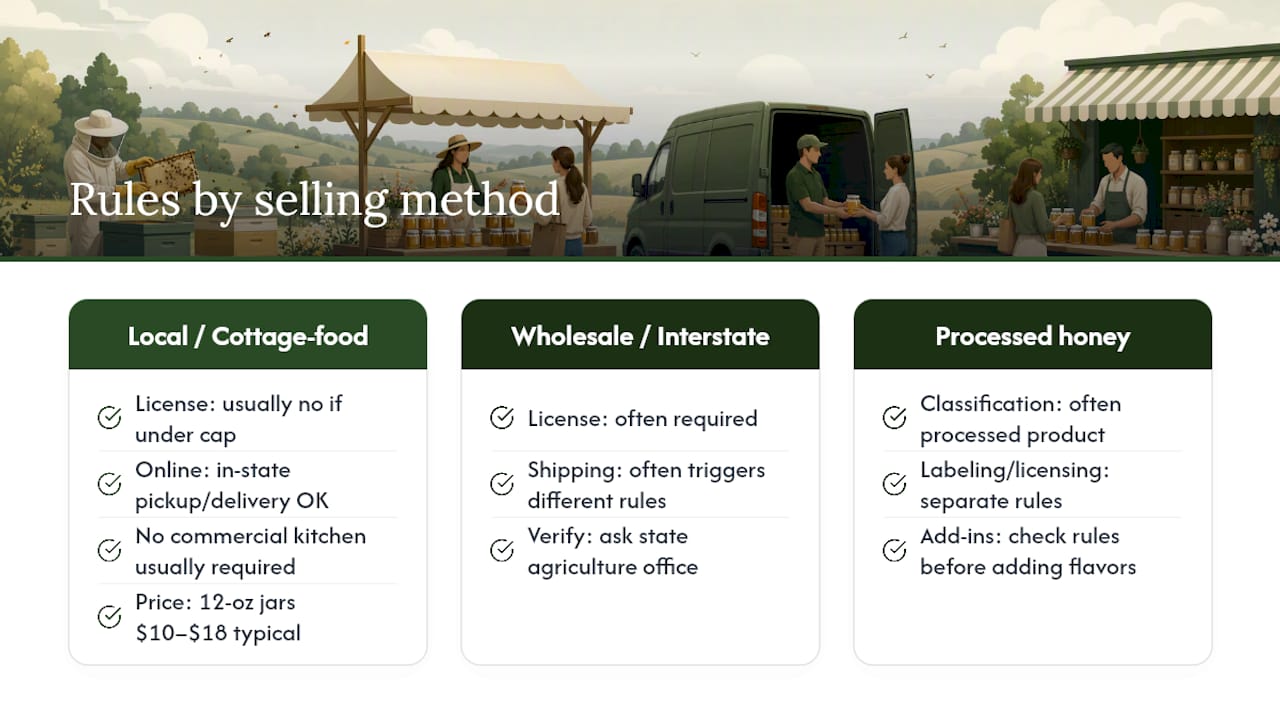
Most states recognize three tiers. A beekeeper or raw-agricultural-product exemption covers pure, unheated honey sold directly by the person who kept the bees, often with no license required at all. A cottage food operator designation covers home-based food production more broadly, and it usually carries an annual revenue cap. Texas, for example, sets that cap at $50,000 in gross income across all cottage foods combined, not just honey. Cross into higher volume, infused products, or wholesale distribution, and you typically need to register as a licensed food manufacturer, which brings inspection and facility requirements.
Before you sell a single jar, check your state's Department of Agriculture or health department site for:
- Apiary or hive registration requirements (some states tie honey sales to registered hive counts).
- Your state's cottage-food revenue cap and what counts toward it.
- Whether shipping honey out of state triggers different labeling or licensing rules.
- Any restrictions on creamed, flavored, or infused honey, which several states treat as a processed product rather than raw honey.
Shipping is where things get complicated. Washington State's guidance spells out when extracted honey can move straight from beekeeper to buyer and when a processor license kicks in, and other states handle it differently enough that you cannot assume your neighbor's rules apply to you. Selling wholesale to a shop, adding ingredients like cinnamon or lavender, or shipping across state lines are the three most common triggers that push you out of the light-touch exemption tier.
Have a handful of basics ready before your first sale: hive registration if your state requires it, a sales-tax permit if your state taxes food sales, a simple record of harvest dates and lot numbers, and a conversation with an insurance agent about liability coverage for direct-to-consumer sales.
Pro Tip: Call your state Department of Agriculture directly instead of relying only on a website FAQ. Rules change year to year, and a five-minute phone call can save you from an expensive labeling mistake.
What Has to Be on Your Honey Label
A compliant label is the cheapest insurance policy you'll ever buy. Get it wrong and you risk a warning at a farmers market; get it right and you can sell with confidence anywhere your state allows.
At minimum, every jar needs:
- The product name ("Honey" or "Raw Honey," matching how you actually process it).
- Net weight, listed in both ounces and grams.
- Your name or business name and address, or the apiary location if your state requires it.
- Any state-specific disclosure wording (some states require "not for infant consumption" language or origin disclosures).
The federal Fair Packaging and Labeling Act sets baseline rules for how net weight and product identity get displayed, and the FDA is explicit that you cannot make unverified health claims on your label or in your marketing. Skip anything implying honey cures allergies or treats illness. Those claims require clinical evidence you almost certainly don't have, and they invite regulatory attention you don't want.
Packaging matters almost as much as the words on it. Offer at least two jar sizes (an 8 ounce or 12 ounce for regular buyers, a larger size for gift-givers), use food-grade glass or plastic jars with tamper-evident seals, and consider a UPC if you plan to sell through a local shop that scans inventory.
Simple, honest wording sells better than clever wording. Something like "Raw. Local. Wildflower." paired with your county or apiary name does more for buyer trust than a paragraph of marketing copy ever will.
A workable sample label reads: product name and floral source ("Raw Wildflower Honey"), net weight ("12 oz / 340 g"), producer name and address or apiary location, a contact phone number or email, and the harvest season if you want to lean into freshness.
Where Should You Sell Honey Direct?
Every channel trades effort for margin differently, and the right starting point depends on how much time you have and how far you want to drive.
- Farmers markets. Setup means a vendor application, a booth fee, and a folding table. You keep full retail price and get immediate customer feedback, but you're committing a Saturday morning every week, and booth fees eat into thin margins if turnout is low.
- On-farm or roadside stand. Setup means a sign, a cash box or card reader, and consistent hours. Zero platform fees and repeat neighborhood traffic, but reach is limited to people who already drive past your property.
- Local shops and co-ops. Setup means a consignment or wholesale conversation with the shop owner and a delivery schedule. You reach shoppers you'd never meet otherwise, but shops typically want a 30 to 40 percent cut, and consistent wholesale volume can push you past a cottage-food cap.
- Online orders with local pickup. Setup means a simple order form or a listing on a platform, plus a pickup location and day. Low overhead and works around your schedule, but shipping honey (it's heavy and can leak) is expensive and sometimes restricted by state rules.
- Subscription or pre-order models. Setup means announcing a harvest window and collecting deposits before extraction. This smooths out seasonal supply and guarantees buyers before you've even pulled frames, but it only works once you have a customer base that trusts you.
If you're short on weekends but want visibility without a booth fee, a digital storefront through something like Harvest Hub gets a listing live in less time than a single market morning, and it works alongside whatever in-person channel you already use rather than instead of it. Check your state's shipping rules before you commit to online orders beyond local pickup. A rule that's fine for a farmers market table can look different the moment a jar crosses a state line.
How Should You Price a Jar of Honey?
Price too low and you're subsidizing your own hobby. Price too high without justification and you'll sit next to a table of unsold jars.
Retail raw honey generally runs about $1 per ounce as a baseline, with regional markets and specialty floral sources (wildflower, orange blossom, tupelo) pushing that higher. A standard 12 ounce jar landing between $10 and $18 is typical for direct-to-consumer sales, and urban farmers markets tend to sit at the higher end of that range.
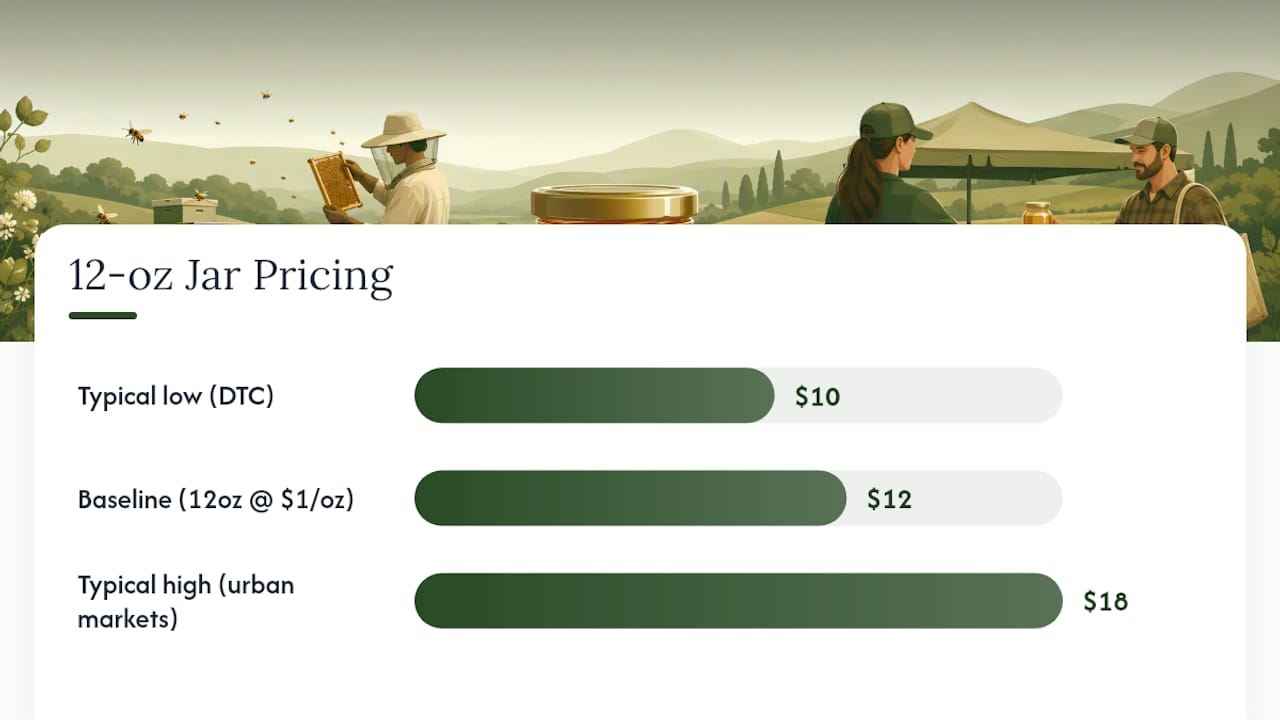
Add those up and a jar selling at a mid-range price with modest total cost leaves you with significant margin, before accounting for your own labor and bee-related overhead like hive maintenance. A modest harvest of several hundred jars at that margin can result in a notable gross profit for a season, not counting time spent extracting and bottling.
A few pricing habits pay off. Price in round numbers ($12, not $11.75) because it speeds up cash transactions at a market table. Offer at least two sizes so buyers self-select into a gift-size purchase without you upselling. If you ever sell wholesale to a shop, expect to price at 50 to 60 percent of your retail price to leave the shop its own margin. And raise your price the following season if you sell out consistently before your harvest runs low. Selling out fast is a pricing signal, not just a popularity win.
Processing and Storage: What Keeps You Compliant
Good honey is simple honey. The mistakes that get sellers in trouble almost always come from overprocessing or under-labeling, not from the honey itself.
Do this: keep extraction equipment food-grade and clean, bottle honey below temperatures that damage its enzymes and flavor, and use new or food-safe containers every time. Don't do this: heat honey above the pasteurization threshold your state allows for raw honey claims, reuse a jar that previously held something else, or label creamed or infused honey as plain "raw honey" when your state classifies it separately.
Some states cap processing temperatures for anything labeled "raw," and a few states treat creamed or infused honey as a distinct product category with its own rules, so check before you experiment with cinnamon-infused batches. Properly bottled honey stores for years at room temperature; crystallization is normal and reversible with a gentle warm-water bath, not a sign of spoilage. If you ship, avoid summer heat that can accelerate fermentation in jars with any residual moisture content.
Pro Tip: Keep a simple log of harvest date, hive location, and lot number for every batch you bottle. If a customer ever has a question, that two-minute record beats a guess every time.
Managing Orders, Payments, and Seasonal Supply
A honey harvest doesn't arrive on a schedule that matches customer demand, so your order process needs to smooth that gap rather than pretend it doesn't exist.
- Take the order, whether that's a market conversation, a text, or an online form.
- Confirm payment (a card reader, a payment app, or a deposit for pre-orders).
- Label and pack the jar, checking the seal before it leaves your hands.
- Hand off at pickup or ship if your state and product allow it.
A spreadsheet or a lightweight order form handles this fine at small volume; you don't need dedicated software until you're moving hundreds of jars. For pre-orders on a limited harvest, cap the number of jars available, collect a 20 to 30 percent deposit, and close the order window a set number of days before extraction. Pack anything shipped in leak-proof, tamper-evident containers, and skip shipping entirely if the weight-to-price ratio doesn't pencil out. A single 12-ounce jar rarely justifies a shipping label. A case of six or more often does.
Setting Up a Digital Farm Stand for Honey Sales
A digital farm stand fills the gap between market days: the customer who wants three more jars on a Tuesday doesn't have to wait for Saturday or text you directly.
- Create a verified profile on a platform like Harvest Hub, which confirms you're a real local producer before buyers ever see your listing.
- Add your product with jar sizes, clear photos, and your price per jar.
- Set pickup or local delivery options so buyers know exactly how they'll get their honey.
- Publish the listing and share the link with your existing customers and local buyers searching nearby.
Look for a platform with verified profiles, real customer reviews, and map-based discovery, since those features do the trust-building work that a folding table at a market does in person. A producer page like this one shows what a finished listing looks like in practice. The real value shows up between market days, when regulars can reorder without a group text chain, and new buyers nearby can find you without ever driving past your farm.
A Beekeeper's First Season Selling Direct
One backyard beekeeper started the way most do: a folding table at a Saturday market, a handwritten sign, and jars that sold out by 10 a.m. some weeks and sat unsold other weeks depending on who showed up.
The fix wasn't a bigger table. It was a pre-order link shared with the same customers between market days. Buyers reserved jars ahead of the next harvest, deposits smoothed out the cash flow, and nothing sat unsold waiting for a Saturday that might not bring the right crowd.
Three habits mattered more than anything fancy: a label that stayed identical jar to jar so regulars recognized it instantly, a price that never wavered mid-season, and a quick follow-up message after every pickup asking if they wanted to be notified for the next batch. None of it required new equipment. It required consistency.
Try a Free Digital Farm Stand This Season
If you've been managing sales through a mix of group texts, market mornings, and word of mouth, a digital farm stand fills the gaps between all three without asking you to become an e-commerce expert.
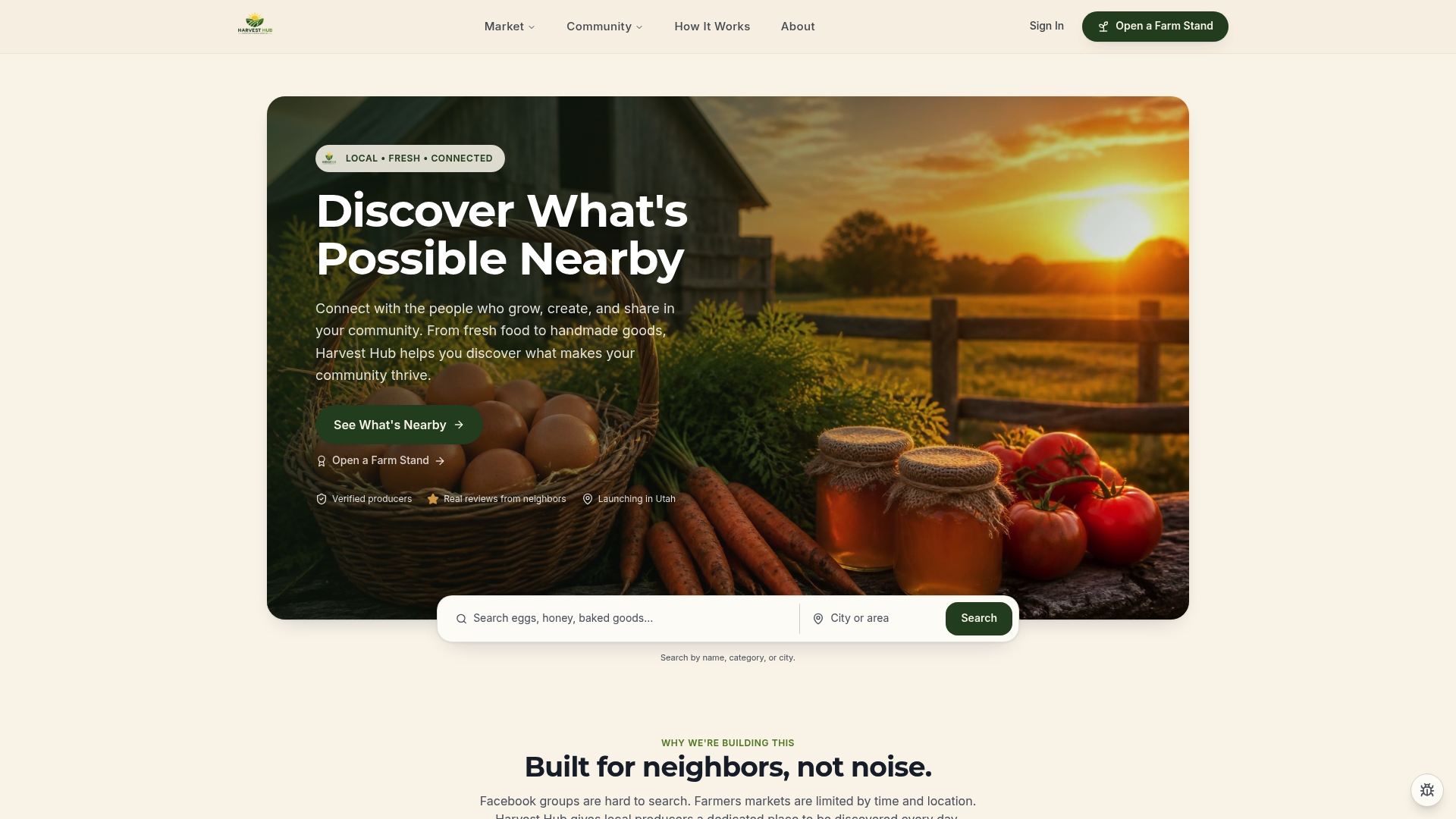
Harvest Hub gives producers a verified profile so buyers know they're dealing with a real local beekeeper, not an anonymous listing. You get a simple product page with jar sizes, pricing, and pickup or delivery options set by you, and local buyers find you through map-based search rather than hoping they catch your next market appearance. It works alongside whatever in-person selling you're already doing. Regulars can reorder the moment they run out instead of waiting for your next Saturday table.
Setting up a listing takes less time than a single market morning. Open a farm stand and publish your first honey listing today, or browse the Harvest Hub marketplace to see how other small producers present their products before building your own.
Where to Verify Rules and Get Started
Confirm labeling basics through the FDA's label-claim guidance, and check state-specific rules like Washington's honey-selling fact sheet or Texas's cottage-food breakdown as examples of how detailed state guidance gets.
- Check your own state Department of Agriculture and county health or extension office for apiary and cottage-food specifics.
- Review Washington's statutory labeling code if you want the binding legal language behind the guidance.
- List your first jar on Harvest Hub once your label and pricing are ready.
Frequently Asked Questions
Do I need a business license to sell honey direct? In most states, no, as long as you stay within your state's cottage-food or raw-agricultural exemption and don't exceed its revenue cap. Selling wholesale or shipping across state lines often changes that.
Can I sell honey online without a commercial kitchen? Usually yes for local pickup or in-state delivery, since raw honey typically qualifies under cottage-food rules. Shipping out of state sometimes triggers different licensing, so verify with your state agriculture office first.
How much should I charge per jar of honey? Most sellers price a standard 12-ounce jar between $10 and $18, based on roughly a $1 per ounce baseline plus regional and floral-source adjustments.
Is creamed or flavored honey treated differently than raw honey? Often yes. Several states classify infused or creamed honey as a processed product with separate labeling and licensing rules, so check before you add cinnamon or lavender to a batch.
What's the easiest way to sell honey between farmers market days? A digital farm stand listing, like the ones producers build on Harvest Hub, lets regulars place orders and arrange pickup without waiting for your next market appearance.
This article is general information, not a substitute for advice from a qualified lawyer. Consult a qualified legal professional about your own circumstances before acting on anything here.
Sources
- selling-honey-in-texas2024.pdf
- SELLING HONEY
- Fda
- How to Sell Your Honey: Complete Guide to Local Sales | HowToRaiseBees
- How to Sell Honey: $10-$18/Jar, No License Needed