

When a negative review lands, post this first: "Thank you for sharing your experience, [Name]. We're sorry we fell short — please reach out to us at [email/phone] so we can make this right." That's your public reply. Your next action: contact the reviewer within 24 hours via direct message or email, log the case with the review URL and issue type, and route it to the right team member.
That's the core of it. A Harvard Business Review study found that businesses that reply to reviews see measurable improvements in their average ratings. The reply above works because it acknowledges the issue, apologizes for the outcome (not just the feeling), and moves the resolution offline without airing details publicly. Sellers on platforms like Harvesthub, where verified reviews are central to buyer trust, can use this exact structure on every farm-stand profile.
- Acknowledge the specific issue, not a generic "your experience."
- Apologize for the situation, not for the reviewer's feelings.
- Offer a concrete next step (contact info, not a vague "we'll look into it").
- Move the conversation offline to protect both parties.
Pro Tip: Write your public reply for the next 100 potential buyers reading it, not just the one reviewer who left it. A calm, accountable reply converts skeptics faster than any marketing copy.
Key Takeaways
Responding to bad reviews consistently and quickly is one of the highest-return reputation investments a business can make, directly affecting local search placement, buyer trust, and average ratings.
| Point | Details |
|---|---|
| Reply within 24–48 hours | Prioritize 1–2 star reviews; same-day response on Google and Facebook protects Local Pack placement. |
| Keep public replies under 100 words | Acknowledge the issue, apologize, offer a contact path, and sign with a real name. |
| Never offer compensation publicly | Move resolution details offline to avoid incentivizing negative reviews from others. |
| Tag and trend every complaint | Monthly categorization turns individual reviews into operational fixes that reduce future complaints. |
| Responding improves ratings | HBR research and Proserpio and Zervas findings both show measurable rating lifts from consistent reply behavior. |
Table of Contents
- How should you respond to bad reviews? Core principles that hold across every platform
- How to adapt your reply when the reviewer tone changes the situation
- Platform-specific tactics for Google, Yelp, TripAdvisor, Facebook, and Glassdoor
- Copy-ready templates and real-world reply examples
- How to detect and report fake or malicious reviews
- Using negative reviews to actually fix your operation
- What the research actually says about replying to reviews
- A team playbook for handling reviews every week
- Why Harvesthub sellers can't afford to ignore review responses
- Sources
How should you respond to bad reviews? Core principles that hold across every platform
The single biggest mistake businesses make is treating a negative review as an argument to win. It isn't. It's a public signal to every future buyer about how you handle problems.
Timing matters more than most people realize. Aim to reply within 24–48 hours. For 1- and 2-star reviews on high-traffic platforms, respond quickly when possible. Flento's analysis of 2,000+ U.S. business profiles found that consistent review response behavior correlates with higher Local Pack placement and better conversion metrics. Slow replies signal indifference.
Keep public replies short. For most consumer complaints, 50–100 words is the target. Longer replies invite back-and-forth, expose more detail than necessary, and bury the key message. A 3–5 sentence reply that acknowledges, apologizes, and offers a path forward does more work than a 300-word defense.
The L.A.S.T. framework (Listen, Apologize, Solve, Thank) gives teams a repeatable structure that scales better than freeform replies. Applied to a public reply, it looks like: name the issue the reviewer raised, say you're sorry it happened, state the next step, and thank them for the feedback. That's it.
- Sign with a real name and role. "Sarah, Customer Experience Manager" lands differently than "The Team."
- Never argue facts publicly. If the reviewer is wrong, acknowledge their experience and offer to discuss details privately.
- Never offer compensation in the public thread. It invites others to post negative reviews for a discount.
- One person signs each reply. Rotating signatures on the same account look disorganized.
- Use templates with required personalization fields. A template that forces you to fill in [reviewer name], [specific issue], and [direct contact] prevents the robotic copy-paste that readers spot instantly.
- Log every interaction. Review URL, date, issue type, assigned owner, resolution status. This data becomes your trend-analysis feed.
Pro Tip: Apologize for the situation, not for the reviewer's feelings. "We're sorry your order arrived damaged" is accountable. "We're sorry you feel that way" is dismissive and readers notice the difference.
How to adapt your reply when the reviewer tone changes the situation
Not every negative review calls for the same response. A furious one-star rant and a polite three-star with a specific complaint need different tones, different lengths, and different calls to action.
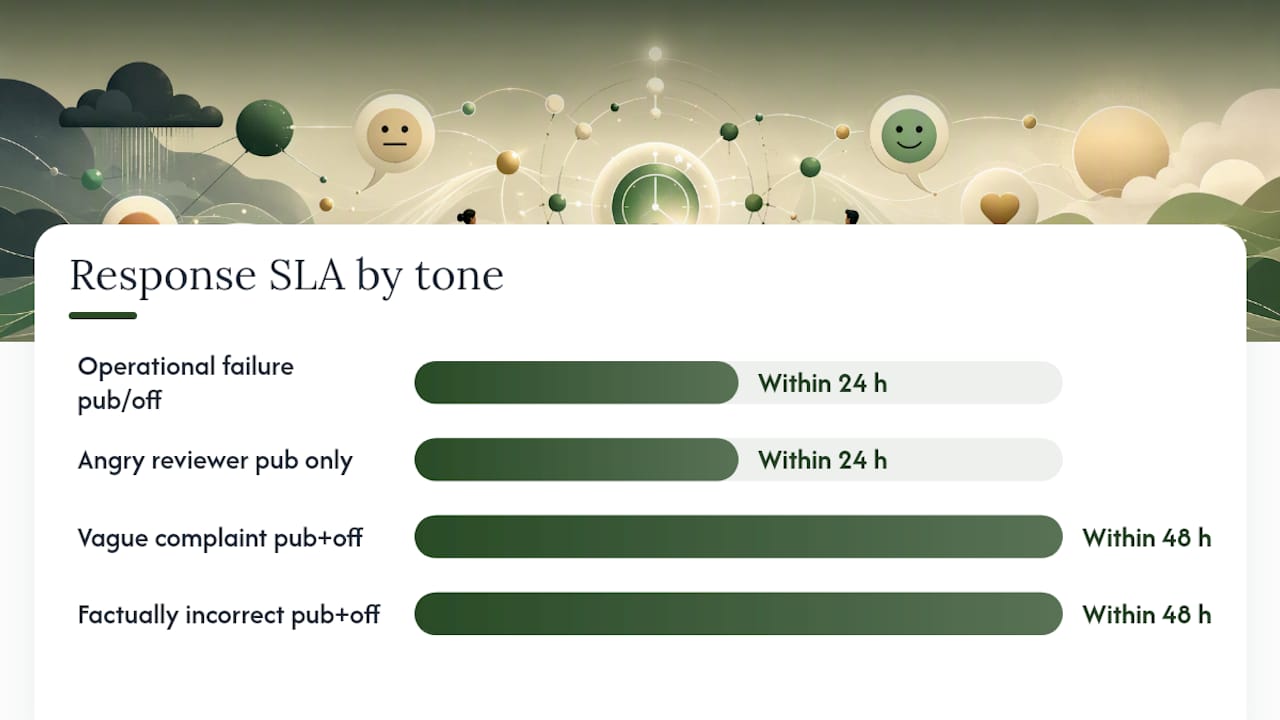
| Situation | Tone to use | Public reply vs. take offline | Suggested CTA | Timing / SLA |
|---|---|---|---|---|
| Valid operational failure (late delivery, wrong item) | Apologetic, accountable | Short public reply + move offline | Direct email or phone to resolve | Within 24 hours |
| Angry/rude reviewer | De-escalating, calm | Brief public acknowledgment only | Invite private contact; do not engage further publicly | Within 24 hours |
| Vague complaint ("bad experience") | Empathetic, curious | Public reply asking for details | DM or email to learn more | Within 48 hours |
| Factually incorrect review | Corrective, polite | One gentle clarification + offer to discuss | Private channel to share facts | Within 48 hours |
| 3-star, no text | Informative, warm | Short thank-you + open door | Invite them to share more | Within 48 hours |
| Product defect report | Apologetic, solution-focused | Public acknowledgment + offline resolution | Replacement or refund via private channel | Within 24 hours |

For a valid operational failure, the reply is direct: "Hi [Name], you're right — your order should have arrived on time and it didn't. We're sorry. Please email us at [address] and we'll make it right immediately." No excuses, no explanation of logistics.
For an angry or rude reviewer, resist the urge to match the energy. "We hear you, [Name], and we're sorry the experience fell short. Please reach out to us directly at [contact] so we can address this properly." That's enough. Future readers see a composed business; the reviewer gets a door opened.
For a vague complaint, you need more information before you can fix anything. "Thank you for the feedback, [Name]. We'd love to understand what happened so we can improve. Could you reach out at [contact]?" Short, non-defensive, and it signals you take all feedback seriously.
For a factually incorrect review, one gentle clarification is acceptable. "Thank you for sharing this, [Name]. Based on our records, [brief factual note]. We'd welcome the chance to discuss this privately at [contact]." One sentence of fact, then move offline. Never turn it into a public debate.
A note on escalation: if a review contains a legal threat, references a safety incident, or includes personally identifying information about a staff member, stop the standard workflow. Flag it for legal counsel before posting any reply. Do not admit liability publicly, and do not engage with defamation claims in a public thread.
Platform-specific tactics for Google, Yelp, TripAdvisor, Facebook, and Glassdoor
Each platform has a different audience, a different algorithm, and a different set of norms. A reply that works on TripAdvisor can feel off-brand on Glassdoor.
Google Reviews
Google is where local search rankings live. Statista's data on consumer reviews posted to Google illustrates the sheer volume of activity on the platform, which is why Google Reviews carry outsized weight for local discovery. Replies here should include your business name and location naturally (it helps with local search context), stay under 100 words, and be signed by a manager or owner. For removal requests, use Google's review management policy and flag reviews that violate content guidelines directly in Google Business Profile. Response SLA: 24 hours for 1–2 star reviews.
Yelp
Yelp's audience skews toward researched, considered purchases. Replies are visible to a community that reads them carefully. Keep the tone professional but human, avoid keyword stuffing (Yelp's algorithm doesn't reward it the way Google's does), and never ask a reviewer to change their rating in the public reply. To flag a review, use Yelp's content guidelines reporting tool. Response SLA: 48 hours.
TripAdvisor
Hospitality is the default register here. Travelers read TripAdvisor replies before booking, so the tone should be warm and specific. Reference the property, the experience type, or the season when relevant. TripAdvisor allows owners to flag reviews through its Management Center. Response SLA: 48–72 hours, though faster is better during peak booking seasons.
Facebook Reviews
Facebook recommendations are tied to social identity, so replies here carry a community feel. Keep them conversational, acknowledge the reviewer by first name, and remember that mutual friends may be reading. For fake or policy-violating reviews, use Facebook's report feature within the review itself. Response SLA: 24 hours.
Glassdoor
Glassdoor reviews come from current or former employees, which means the stakes are different. Replies should be professional, measured, and never reference specific personnel situations or internal HR matters. Acknowledge the feedback, state what the company values, and invite the reviewer to connect through official HR channels. Glassdoor's employer response guidelines outline what's permitted. Response SLA: 48–72 hours. Sign at the founder or HR director level.
Pro Tip: On Google, weave your city or neighborhood into the reply naturally. "We're proud to serve the [City] community" does double duty: it reads as genuine and reinforces local search signals.
Copy-ready templates and real-world reply examples
Templates save time and protect consistency. The risk is that they sound like templates. The fix is mandatory personalization fields that force a human touch before posting.
Template 1: Valid complaint, product or service failure (1–2 star) "Hi [Name], thank you for letting us know. We're sorry [specific issue] happened — that's not the standard we hold ourselves to. Please contact us at [email/phone] so we can [specific resolution: replace, refund, reschedule]. We appreciate your patience."
Template 2: Vague or unclear complaint (2–3 star) "Thank you for the feedback, [Name]. We'd genuinely like to understand what went wrong so we can improve. Please reach out at [contact] — we're listening."
Template 3: Angry or emotional reviewer (1 star) "[Name], we hear you and we're sorry the experience was frustrating. Please contact us directly at [email/phone] so we can address this properly. We want to make it right."
Template 4: 3-star, no text "Thank you for taking the time to leave a rating, [Name]. If there's anything we could have done better, we'd love to hear it at [contact]. We hope to see you again."
A note on template performance: The most effective public replies are the ones that don't read like templates. Before posting, fill in every bracketed field, cut any sentence that doesn't add information, and read it aloud. If it sounds like a form letter, rewrite one sentence in your own voice. That single edit is what separates a reply that builds trust from one that signals you're running a script.
Before and after: personalizing a template
Before (robotic): "Thank you for your feedback. We are sorry to hear about your experience. Please contact our customer service team."
After (human): "Hi Maria, thank you for flagging the packaging issue with your egg order. That's not how we want your delivery to arrive. Please email us at [address] and we'll send a replacement this week."
The after version names the reviewer, names the specific problem, and states a concrete resolution timeline. It takes 30 seconds longer to write and does substantially more work.
For measuring template performance: track reviewer update rates (did the reviewer revise their rating after your reply?), resolution rate (was the issue resolved within your SLA?), and rating delta over rolling 30-day periods. These three metrics tell you whether your reply workflow is working.
How to detect and report fake or malicious reviews
Not every negative review deserves a response. Some deserve a report.
Signals a review may be fake or malicious:
- The reviewer has no order record or transaction history with your business.
- The review was posted within hours of a competitor's promotional push.
- The language is generic ("terrible place, avoid") with no specific detail.
- Multiple reviews with similar phrasing appear in a short window.
- The reviewer's profile is brand new with no other review history.
Steps to take:
- Verify your records. Check your order management system, booking log, or CRM for any transaction tied to the reviewer's name, email, or date range.
- Respond minimally in public (if at all). A brief, calm note that you have no record of this experience and invite them to contact you directly is sufficient. For clear spam, skip the public reply entirely.
- Gather evidence. Screenshot the review, note the date and time, and document why you believe it violates platform policy (no transaction record, competitor IP, policy violation type).
- Use platform reporting channels. Google Business Profile, Yelp's content guidelines tool, TripAdvisor's Management Center, and Facebook's report feature all have formal removal request processes. Search Engine Land's guidance on Google removal requests covers the specific steps for Google.
- Escalate internally. If the review is part of a coordinated attack or contains a legal threat, loop in your legal counsel before taking further action.
- Follow up on the report. Platforms rarely confirm removal decisions quickly. Log the report date and check back within 7–14 days.
When in doubt about whether to respond publicly: if the review is clearly fake spam, report it silently. If it's ambiguous, a single calm public note ("We have no record of this visit — please contact us at [email] so we can investigate") protects your reputation without escalating.
Using negative reviews to actually fix your operation
A negative review is the cheapest market research you'll ever get. The businesses that treat it as data rather than drama are the ones that stop seeing the same complaints repeat.

Triage and tag every review by issue type (delivery, product quality, communication, pricing), product or service SKU, and location if you operate multiple sites. After 30 days, patterns emerge that individual reviews obscure.
A simple monthly process:
- Collect: Pull all reviews from every active platform into a single log (a shared spreadsheet works fine at small scale).
- Categorize: Tag each by issue type and severity.
- Fix: Assign the top recurring issue to an owner with a resolution deadline.
- Report back: When the fix is live, update your public reply on the original review if the platform allows it, or post a response to new reviews mentioning the change. "We've updated our packaging process to prevent the damage several customers reported last month" is a sentence that converts skeptics.
Recommended metrics to track monthly: response rate (percentage of reviews that received a reply), resolution rate (percentage of complaints resolved within SLA), and rating delta (average rating change over the period).
Bazaarvoice's research shows that profiles with a mix of review sentiment, including some negative reviews, can see up to about 13% higher revenue than those with near-perfect scores. Buyers trust a business that has visible complaints and visible responses more than one with suspiciously uniform five-star ratings.
Proactive prevention reduces the volume of negative reviews at the source. Post-transaction surveys (sent within 24 hours of delivery or service) catch dissatisfied customers before they reach a public platform. Experience filters, where a low survey score triggers a direct outreach rather than a review request, are standard practice among businesses with high review volumes. Staff training on complaint handling, particularly for front-line roles, addresses the human causes of most service failures. Food and farm businesses looking to resolve recurring operational issues that drive complaints can also benefit from food technology and operational consulting services that address root causes rather than symptoms.
What the research actually says about replying to reviews
The evidence for investing in review responses is solid, though it's worth reading it with appropriate context.
The HBR study on replying to customer reviews found that businesses engaging with reviewers see measurable improvements in average ratings. The mechanism isn't mysterious: when businesses respond, dissatisfied customers sometimes update their ratings, and the visible accountability tends to attract more positive reviews from satisfied customers who see that feedback is taken seriously.
Reviewz documents findings from Proserpio and Zervas suggesting that responding to reviews can lift average ratings by roughly 0.12 stars and increase positive review flow in some samples. That may sound small, but on a platform where the difference between 4.1 and 4.3 stars affects click-through rates, it compounds.
Flento's analysis of 2,000+ U.S. business profiles found that consistent response behavior correlates with better Local Pack placement and improved conversions. Local Pack visibility is effectively free advertising, and response rate is one of the behavioral signals that influences it.
A few caveats worth noting: most of this research covers hospitality and retail at scale. Results for small local producers, farm stands, or niche marketplaces may vary. The directional finding, that responding is better than not responding, holds consistently across studies. The exact magnitude depends on industry, platform, and review volume.
A team playbook for handling reviews every week
Reputation management fails when it's nobody's job. The fix is a simple role structure and a weekly rhythm.
Roles:
- Monitor: One person checks all active review platforms daily (or sets up alerts via Google Business Profile notifications and platform email digests).
- First responder: The same person, or a designated customer service rep, drafts and posts public replies within SLA.
- Escalation owner: A manager or founder reviews any 1-star review, legal flag, or safety-related complaint before a reply goes live.
- Resolution owner: The ops or product team member responsible for fixing the root cause and closing the loop.
SLA targets by severity:
| Review severity | Platform | Response time target |
|---|---|---|
| 1–2 star (operational failure) | Google, Yelp, Facebook | Within 24 hours |
| 1–2 star (safety or legal flag) | Any | Escalate immediately; reply after legal review |
| 3 star (with text) | Any | Within 48 hours |
| 3 star (no text) | Any | Within 48–72 hours |
| 4–5 star (negative element noted) | Any | Within 72 hours |
| Glassdoor (any rating) | Glassdoor | Within 48–72 hours |
Public reply checklist before posting:
- Reviewer's name included (first name only is fine)
- Specific issue named, not a generic "your experience"
- Apology present and accountable
- Concrete next step with contact info
- No compensation offered publicly
- Signed with real name and role
- Under 100 words for consumer platforms
Private follow-up checklist:
- Contact reviewer within SLA via DM or email
- Log: review URL, date, issue type, resolution offered, outcome
- Assign resolution code (resolved, unresolved, no response from reviewer)
- If resolved: invite reviewer to update their rating (once, not repeatedly)
Weekly review-squad meeting (15 minutes):
- Review open cases and SLA compliance
- Identify the top recurring issue from the past 7 days
- Assign a fix owner if a pattern is confirmed
- Check rating delta vs. prior week
KPIs to track: response rate, average response time, resolution rate, rating delta (30-day rolling), and reviewer update rate (percentage of reviewers who revised their rating after a reply).
Why Harvesthub sellers can't afford to ignore review responses
Here's what I've seen working with local producers on Harvesthub: the sellers who treat every review as a conversation, not a verdict, build buyer loyalty faster than any promotional push could. A farm stand with a handful of honest reviews and thoughtful replies consistently outperforms one with more listings but no engagement.
Harvesthub is built around verified profiles and real community reviews precisely because trust is the currency of local food commerce. When a buyer sees that a seller at a place like Moon Farms Country Market or FarmBox SF responds to feedback promptly and professionally, it signals something a five-star average alone can't: that there's a real person behind the stand who cares what happens after the sale.
The Harvesthub Trust Center outlines how the platform verifies sellers and manages review integrity. For sellers who want to put these workflows into practice on their own farm stand, the Open a Farm Stand page is the starting point. The platform's review tools, verified profiles, and community-facing features are designed to make the kind of reputation management described in this guide practical at small scale, not just for enterprise customer service teams.

The food businesses that get this right, whether they're a backyard grower or a multi-location CSA, share one habit: they respond. Every time, within the window, with a real name attached. That habit, more than any marketing spend, is what turns a negative review into a net positive for the brand.
Sources
- Study: Replying to Customer Reviews Results in Better Ratings | HBR
- Consumer reviews posted on Google | Statista
- How to respond to negative reviews: the L.A.S.T. framework + 7 real examples · Reviewz
- How to Respond to Negative Reviews: Templates (2026) | Flento