
Set your price by starting with full cost per unit as the floor, adding a target margin, then adjusting by sales channel and current market data. That's the whole framework. Everything else in this guide is the math behind it.
Your first move: calculate what it actually costs you to produce one pound, one bunch, or one dozen of your product. Until you know that number, every price you set is a guess. The Cornell Small Farms Program provides step-by-step worksheets that walk you through direct costs, overhead, and per-unit math — a solid starting point before you set a single price tag.
One rule of thumb worth anchoring to early: direct-to-consumer channels typically let you capture 60–80% of retail price, while commodity wholesale channels deliver only 15–40%. That gap is why channel choice matters as much as price itself. The USDA Agricultural Marketing Service publishes weekly terminal market reports you can use to check whether your prices are in range. Platforms like Harvesthub give you a direct-to-consumer channel to test prices with local buyers and capture more of that retail share.
Key Takeaways
Your price floor is your full cost per unit — every price you set must clear that number before it can be called profitable.
| Point | Details |
|---|---|
| Calculate full unit cost first | Add direct inputs, labor, packaging, overhead, and owner labor before setting any price. |
| Use channel benchmarks | D2C channels capture 60–80% of retail; wholesale delivers 15–40% — channel choice shapes your margin. |
| Test prices in market | Run a 4-week price test, track units sold, and adjust by 10–15% increments based on real demand. |
| Use USDA AMS for benchmarking | Check terminal market reports weekly to confirm your prices are in range with current wholesale rates. |
| Harvesthub for direct testing | List products on Harvesthub to reach local buyers, test prices between market days, and build premium-supporting reviews. |
Table of Contents
- How do you price farm produce? Start with full cost per unit
- What pricing methods work best for farm products?
- How does your sales channel change the price you should charge?
- Where can you find current market prices to benchmark against?
- How do seasonality, quality, and pack size affect your price?
- Key benchmarks for farm pricing: what the data actually shows
- Sample pricing worksheet and three worked examples
- How do you know if your farm is actually profitable?
- What growers actually learn when they do the math
- Harvesthub: test your prices with real local buyers
- Sources
How do you price farm produce? Start with full cost per unit
Before you can set a profitable price, you need to know what it costs to grow, pack, and deliver one unit of your product. Most growers who underprice aren't being generous — they're just missing costs.
The cost categories to include
Every product you sell draws from the same pool of farm expenses. Capture all of them:
- Direct inputs: seed, transplants, feed, fertilizer, pest management, irrigation water
- Harvest labor: hours spent picking, sorting, and grading, priced at a real hourly rate
- Packing and packaging: boxes, bags, rubber bands, clamshells, labels, twist ties
- Cold storage and handling: refrigeration electricity, ice, cooler depreciation
- Transport and distribution: fuel, vehicle depreciation, delivery time
- Marketing: farmers market fees, booth costs, website hosting, photography
- Fixed overhead: equipment depreciation, land cost or rent, insurance, utilities apportioned to this crop
- Owner labor: your own hours at a defensible hourly rate (more on this below)
Converting batch cost to per-unit cost
The formula is straightforward:
Cost per unit = Total batch cost ÷ Number of sellable units
A worked example with tomatoes: say your total cost for a 200 lb harvest of slicing tomatoes (inputs, labor, packaging, overhead share) comes to $180. After culling, you have 170 lbs of sellable product.
$180 ÷ 170 lbs = $1.06/lb cost floor
That $1.06 is your absolute floor. Sell below it and you're paying customers to take your tomatoes.
For mixed-cost items — equipment used across multiple crops, shared utilities — apportion by the percentage of field space or production hours that crop represents.
Seasonal cost calculation checklist
Follow these steps at the start of each growing season, and again mid-season when input costs shift:
- List every input purchased for this crop and record the cost.
- Estimate total labor hours (planting through delivery) and multiply by your chosen hourly rate.
- Add packaging cost per expected unit (price per box or bag ÷ units per container).
- Apportion fixed overhead by crop share (acreage or revenue percent).
- Sum all costs to get total batch cost.
- Estimate sellable yield (account for typical cull rate — often 10–20%).
- Divide total batch cost by sellable units to get cost per unit.
- Record this number. It is your price floor for every channel.
Pro Tip: Value your own labor at the rate you'd pay a skilled hired hand in your area — typically $15–$25/hour depending on region and task complexity. If you wouldn't work for free for a neighbor, don't work for free for your farm. Owner labor is a real cost; leaving it out just hides the subsidy you're giving your buyers.
What pricing methods work best for farm products?
Three methods cover nearly every farm pricing situation: cost-plus, gross-margin (target percent), and market/value pricing. The right one depends on whether you're selling a commodity, a direct-retail item, or a specialty product.
Cost-plus is your floor check. Gross-margin pricing sets a target return. Market/value pricing anchors you to what buyers will actually pay. In practice, most growers use all three — cost-plus to confirm viability, market data to set the ceiling, and gross-margin to find the number in between.
Cost-plus example: bulk salad greens
You grow mixed salad greens. Your cost per pound is $1.40 (inputs, labor, packaging, overhead).
Price = Cost ÷ (1 − target margin) $1.40 ÷ 0.70 = $2.00/lb
This method works well for commodity wholesale where buyers have price expectations and you need to confirm you can meet them profitably. If the market price is $1.60/lb and your cost is $1.40, you have a problem — not a pricing problem, a production cost problem.
Margin-based example: jarred salsa
You produce small-batch salsa. Total cost per jar (ingredients, labor, jar, lid, label) is $3.20.
$3.20 ÷ 0.50 = $6.40/jar
Gross-margin pricing is the right tool for value-added items because it builds in enough cushion to cover the higher labor and packaging costs these products carry. A small-batch food production guide notes that producers often use an ingredient-cost multiplier (roughly 3×) as a starting point, then add labor and packaging on top — which lands in a similar range when margins are calculated properly.
Market-based example: heirloom tomatoes
Your heirloom tomatoes cost $1.20/lb to produce. At your Saturday farmers market, comparable heirlooms sell for $4.00–$5.00/lb. Your cost-plus price would be $1.71/lb at a 30% margin. The market will bear $4.50/lb.
Here, value pricing is the right call. The premium reflects variety, flavor, and the direct-market experience — not just your cost.
The decision rule: use cost-plus for commodity wholesale, gross-margin for value-added packaged goods, and market/value pricing for specialty or direct-retail items where demand supports a premium.
How does your sales channel change the price you should charge?
Channel determines your final buyer, their price expectations, and how much of the retail dollar you actually keep. A tomato that retails for $4.00/lb at a farm stand might move through a wholesale distributor at $1.20/lb. Neither price is wrong — they serve different buyers with different cost structures.
| Channel | Best for | Pricing method | Typical % of retail | Unit basis | Costs usually included |
|---|---|---|---|---|---|
| Wholesale / distributor | High-volume commodity crops | Cost-plus, market-based | 15–40% | Per lb, per carton | Inputs, harvest labor, basic packaging |
| Restaurant / food service | Specialty, heirloom, herbs | Market-based, value | 35–40% | Per lb, per flat, per case | Inputs, labor, delivery, QA sorting |
| Farm stand / farmers market | Direct retail, all products | Value, cost-plus | 80–100% | Per lb, per unit, per bunch | All costs including booth fee, travel |
| CSA (subscription box) | Mixed seasonal produce | Cost-plus, gross-margin | 60–80% | Per share/week | All costs, packaging, admin |
| Online / community marketplace | Direct retail, specialty, eggs, baked goods | Value, market-based | 60–80% | Per unit, per dozen, per lb | All costs, platform fee if applicable |
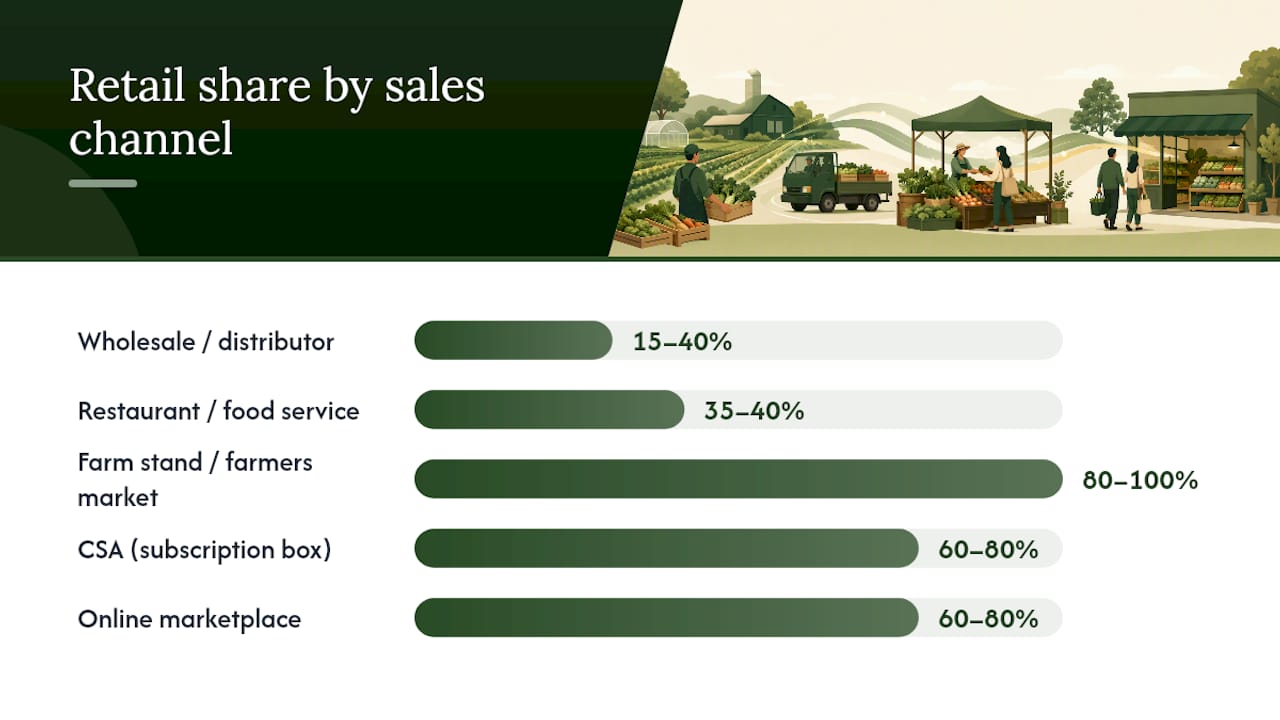
Direct-to-consumer channels — farm stand, CSA, and online marketplace — consistently deliver the highest share of retail price, which is why USDA ERS data shows specialty and direct-market growers capturing 40–70% of retail value versus 15–40% for commodity channels.
Selling to restaurants and wholesale buyers
Restaurants want consistency, reliability, and spec-grade product. A few things that matter when you approach them:
- Bring a written spec sheet: variety, average size, pack weight, harvest-to-delivery window.
- Price per case or flat, not per pound — chefs think in case costs.
- Build delivery cost into your price; don't absorb it as a favor.
- Offer a standing weekly order at a slight discount (5–8%) in exchange for volume commitment.
- Expect payment terms of net-14 to net-30; price accordingly.
For unit conversion: if a restaurant wants a price per pound but you're working from a 25 lb flat, divide your flat price by 25. A $35 flat of specialty greens = $1.40/lb to the restaurant. Check that against your cost floor before you commit.
Where can you find current market prices to benchmark against?
Use USDA AMS Market News terminal reports, regional terminal data, and Cornell's price information guides as your primary benchmarking sources. These are free, updated weekly, and specific enough to be useful.
The highest-value data sources to check regularly
USDA AMS Market News / MyMarketNews — the most authoritative source for wholesale terminal prices by commodity, pack type, and origin. Search by crop and region. Reports are published weekly and often daily for major terminals.
Terminal market reports — the Chicago Terminal Market report shows, for example, arugula ranging from $10.50–$18.00 depending on pack, broccoli crowns at $23.00–$26.00 per carton, and bell peppers at $24.00 per 15 lb carton. The New York terminal shows asparagus jumbo at $48–$74 depending on origin, and iceberg lettuce at $18–$24 per 24-count carton. These are your wholesale ceiling benchmarks.
Cornell Small Farms price pages — useful for state-level and regional data, especially for crops that don't appear in major terminal reports.
State extension price surveys — many land-grant universities publish seasonal price surveys for their region. Search "[your state] extension vegetable price survey."
Converting terminal prices to $/lb
Terminal reports list prices by carton, flat, or crate. Here's the conversion:
Price per lb = Carton price ÷ Net weight of carton
Example: bell peppers at $24.00 per 15 lb carton. $24.00 ÷ 15 lbs = $1.60/lb wholesale terminal price
That's the price a distributor pays at the terminal. Your farm-gate price to a local restaurant or co-op should sit somewhere between your cost floor and this terminal price, adjusted for your quality, freshness advantage, and delivery convenience.
Local intel checklist
Terminal prices are a ceiling, not a target. Supplement them with:
- Visit two or three farmers markets in your area and record prices for your crops.
- Call a local grocery produce buyer and ask what they're currently paying per case.
- Note competitor pack sizes — a $3.00 bunch at one stand may be 4 oz while yours is 6 oz.
- Update your benchmarks at the start of each season and again at peak harvest when supply spikes.
How do seasonality, quality, and pack size affect your price?
Higher quality, out-of-season supply, and consumer-friendly pack sizes all justify premiums above your base price. The key is building these adjustments into a simple tiered system rather than pricing by feel each week.
A useful starting framework: set your base price for standard-grade, in-season product at your target margin. Then add or subtract percentage premiums from there.
Grade and quality tiers work like this in practice. Grade A product (uniform size, no blemishes, market-ready) gets your full price.
Seasonal premiums reflect supply and demand. Late-season tomatoes, when supply is thinning, often hold price or even rise. Track your own sales data across seasons — after two or three years, you'll see the pattern clearly.
Pack size affects perceived value more than most growers realize. A $5.00 pint of cherry tomatoes feels different to a buyer than $3.00/lb of the same tomatoes sold loose, even if the math is similar. Smaller, pre-weighed packs reduce buyer hesitation at a farm stand and often support a higher effective per-pound price.
Pro Tip: When you sell seconds, label them clearly and price them as a separate SKU — "Sauce Tomatoes" or "Jam Berries" — rather than discounting your regular product. This protects your Grade A price point and trains customers to see the two as different products, not the same thing on sale. A permanent discount on your main SKU is much harder to reverse than a separate seconds line.
Key benchmarks for farm pricing: what the data actually shows
The most useful single benchmark for any grower: direct-to-consumer sales typically deliver 60–80% of retail price, while commodity wholesale channels deliver only 15–40%, according to USDA ERS price spread data. That spread is the financial case for building direct-market channels alongside any wholesale business.
| Metric | Typical range | What it means for your pricing |
|---|---|---|
| Farm-gate share, commodity wholesale | 15–40% of retail | Price wholesale at ~2–3× your cost floor to stay viable |
| Farm-gate share, direct-to-consumer | 40–70% of retail | D2C lets you set near-retail prices; target 60–80% of local retail |
| Suggested wholesale price (D2C baseline) | ~50–60% of your D2C price | Use this to quote distributors or co-ops without underselling |
| Gross margin, value-added products | 45–60% | Standard range for jarred, baked, or processed farm goods |
| Cull/spoilage allowance | 10–20% of yield | Build into sellable unit count before dividing batch cost |
Sanity check steps: Once you've set a price, run these three checks.
- Compute your farm-gate share: (your price ÷ local retail price) × 100. Compare to the benchmark range for your channel.
- If your farm-gate share is below the low end of the range, your price may be too low — or your costs are too high relative to market.
- If your farm-gate share is above the high end, confirm you're not pricing yourself out of the channel. For D2C, being above 80% of retail is fine if demand supports it.
Tracking farm-gate price per unit across seasons and comparing it against unit cost is one of the most useful management habits a small farm can build. A small basis shift or a quality downgrade can erase a thin per-unit margin quickly.
Sample pricing worksheet and three worked examples
The worksheet below covers the fields you need for any product. Copy these columns into a Google Sheet or Excel file and fill one row per product.
For value-added or baked goods, a recipe yield and batch-scaling approach helps convert total ingredient cost to per-unit cost before applying the margin formula above.
Example 1: Salad mix per pound
Batch: 50 lbs harvested, 42 lbs sellable after culling. Total costs: $48 inputs, $30 labor (3 hrs × $10/hr hired + 1 hr owner at $20), $8 packaging, $14 overhead = $100 total.
Example 2: Jarred salsa per jar (8 oz)
Batch: 60 jars. Total costs: $54 ingredients, $45 labor (3 hrs × $15), $24 jars/lids/labels, $12 overhead = $135 total.
Price at $5.50/jar for farm stand; $3.50/jar wholesale.
Example 3: Herb bunches (basil, per bunch)
Batch: 80 bunches. Total costs: $20 seed/inputs, $32 labor (2 hrs × $16), $8 rubber bands/bags, $10 overhead = $70 total.
Price at $2.75/bunch.
Live price testing protocol
Once you have a calculated price, test it before locking it in permanently:
- Set your calculated price for the first two market days.
- Record units sold and any customer comments about price.
- If you sell out in the first hour, raise price by 10–15% the following week.
- If you consistently bring product home, lower price by 10% or adjust pack size.
- After four weeks, compare revenue per market day and choose the price that maximizes total revenue, not just units sold.
- Revisit the worksheet whenever a major input cost changes by more than 10%.
How do you know if your farm is actually profitable?
Never sell below full cost unless you have a specific, temporary, subsidized reason — and a written plan to stop. Selling below cost to "build a customer base" works only if you can afford to subsidize buyers indefinitely, which almost no small farm can.
Breakeven formula:
Breakeven units = Total fixed costs ÷ (Price per unit − Variable cost per unit)
If your fixed costs for a season are $2,000, your price per lb is $3.00, and your variable cost per lb is $1.50, you need to sell at least 1,334 lbs to break even. Know that number before you plant.
Monthly review checklist
- Compare actual yield to projected yield. A 15% yield shortfall raises your cost per unit — recalculate.
- Check input cost changes. If fertilizer or packaging costs rose, update your worksheet.
- Track spoilage and unsold inventory. Consistent spoilage above 20% signals a pricing or volume problem.
- Review your farm-gate share against the USDA ERS benchmarks from the data table above.
- Confirm each product is covering its full cost, including owner labor.
Red flags and immediate fixes
Regularly selling below breakeven: Stop and recalculate costs. Either raise price, reduce costs, or exit that product.
Untracked labor: If you can't say how many hours went into a product, you can't price it. Start a simple time log — even a notes app works.
Frequent unsold inventory: Either you're overproducing for your channel, your price is too high for that channel, or your product needs better presentation.
Customers who always ask for a discount: You may have trained them to expect one. Introduce a formal seconds line instead of discounting your main product on request.
What growers actually learn when they do the math
Most growers who move from gut-pricing to cost-based pricing describe the same experience: the calculated price feels high at first. That feeling is almost always a sign the math is right — it's the first time all the real costs, including owner labor, are visible in one number. A grower who had been selling mixed greens at $2.50/lb at a local market ran the worksheet and found a true cost of $2.10/lb. The margin was so thin that a single bad week of spoilage erased the season's profit on that crop. After raising the price to $3.75/lb and shifting half the volume to a CSA channel, the math changed entirely.
The worksheet doesn't tell you what the market will bear — that's what your price tests are for. But it tells you the one number you can't negotiate: the floor below which every sale costs you money.
Try the worksheet on your highest-volume product first. Then test the resulting price at your next market or on a Harvesthub listing where local buyers can find you directly.
Harvesthub: test your prices with real local buyers
Pricing a product on paper is one thing. Seeing how local buyers respond is another. Harvesthub gives you a digital farm stand where you can list products at your calculated price, reach verified local buyers, and adjust based on real demand — without waiting for the next Saturday market.
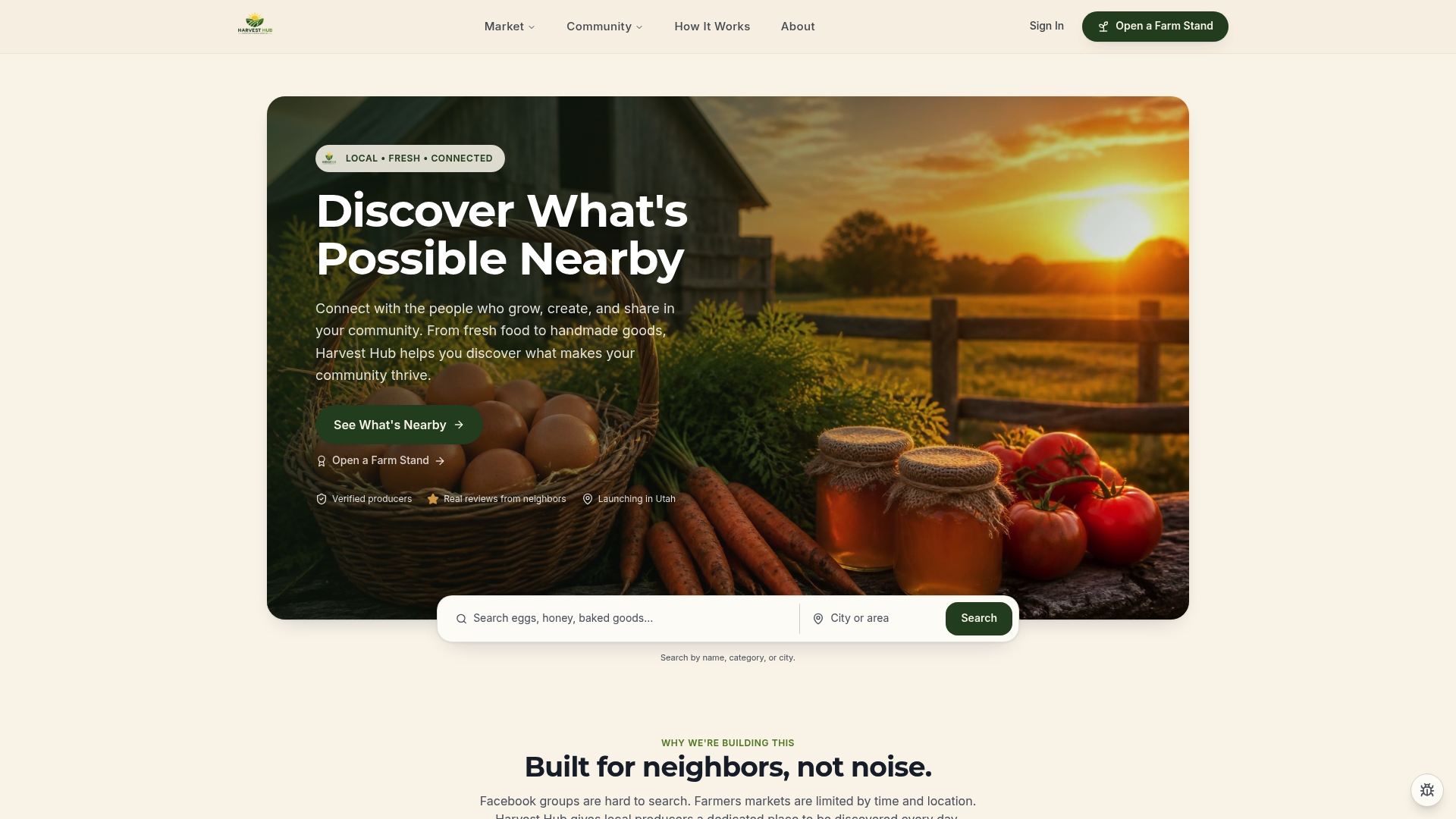
Producers on Harvesthub set their own prices and update them any time, so testing a price adjustment takes minutes, not weeks. The platform's verified profiles and buyer reviews build the kind of trust that supports premium pricing — buyers who know your farm and your practices are less price-sensitive than anonymous market shoppers. Features that matter for pricing and testing:
- Digital farm stand: list products with custom prices, pack sizes, and descriptions
- Local buyer discovery: your listings appear in map and category searches for buyers in your area
- Verified profiles and reviews: build the reputation that justifies a premium
- Real-time updates: change a price or add a new SKU between market days
Farms like Moon Farms Country Market use their Harvesthub listing to present tiered products and seasonal offerings to a consistent local audience. Open your farm stand on Harvesthub and start testing your calculated prices with buyers who are already looking for what you grow.
Sources
- USDA ERS — Price spreads from farm to consumer
- Pricing Farm Products - Cornell Small Farms Program
- USDA Agricultural Marketing Service (AMS)
- Chicago Terminal Market Vegetable & Herb Prices: August 6, 2026 | IndexBox (USDA AMS-based report)
This article provides general pricing guidance for educational purposes. Input costs, market prices, and regulatory requirements vary by region, crop, and sales channel. Confirm current market rates with USDA AMS and consult your state extension service or a farm business advisor for guidance specific to your operation.
This article is general information, not a substitute for advice from a qualified financial advisor. Consult a qualified financial professional about your own circumstances before acting on anything here.