

Founding member benefits are the perks a business or organization offers the first cohort of people who join before the product, platform, or program is fully built out. In exchange for taking on that early risk, founders typically get a mix of six things: early access, discounted or locked-in pricing, a real voice in what gets built next, exclusive events, public recognition, and priority treatment on support or perks. The trade organizers should hold themselves to is just as important: cap the cohort, set a hard closing date, and promise a specific deliverable within the first week.
- Early access to features, inventory, or content before the general public
- Discounted or locked pricing that rewards joining before launch
- Direct influence over what gets built or offered next
- Invitations to exclusive events, workshops, or previews
- Public recognition as an original supporter
- Priority support and first pick of limited extras
Key Takeaways
Founding member programs work when organizers pair a real discount with a capped cohort, a hard deadline, and a first-week deliverable that proves the promise wasn't just marketing.
| Point | Details |
|---|---|
| Six core benefits | Early access, locked pricing, influence, exclusive events, recognition, and priority support define most founding tiers. |
| Price at 40 to 50% off | Lock founders in well below the eventual standard price so joining early feels like an obvious decision. |
| Cap and close fast | Use a 10 to 30 member cap for validation and a five to seven day open cart to create real urgency. |
| Protect both sides in writing | Spell out what breaks the forever rate and add a minimum-cohort refund clause before you take payment. |
| Model it on a real platform | Harvest Hub lets producers pair discounted Producer Pro pricing with verified profiles to build founding-member trust from day one. |
Table of Contents
- What Founding Member Benefits Look Like in Practice
- How Should You Price and Cap a Founding Tier?
- Launching and Onboarding a Founding Cohort
- Founders Gain a Discount, Organizers Gain Proof
- How Harvest Hub Producers Use Founding Perks
- Tax and Financial Considerations for Founding Tiers
- The Real Downsides of Being a Founding Member
- What Most Founding-Tier Advice Gets Wrong
- Set Up Your Founding Cohort on Harvest Hub
- Sources
What Founding Member Benefits Look Like in Practice
Early access rarely means a finished product. It usually means a working beta, a partial feature set, or a soft-launched offering that improves month to month. A software founder might promise a usable dashboard by month one and full reporting by month three. A farmer opening a subscription box might promise the first delivery within two weeks of signup, with the full seasonal rotation locked in by the third month, similar to specialty offerings from Pat’s Prime Cuts & Deli.
Discounted or grandfathered pricing is the benefit most people join for. Standard practice locks founders in at a meaningful discount below the eventual standard price, according to the pricing mechanics laid out by launch-focused membership guides. If the long-term price will be $30 a month, founders often pay a permanently lower amount as long as their membership stays active without a lapse.
Direct influence separates a founding tier from a simple early-bird discount. That might mean monthly feedback calls, a private vote on which feature ships next, or a shared roadmap document founders can comment on directly.
Exclusive events, recognition, and priority extras round out the package: a founders-only workshop, a name on a public "wall of founders," first access to limited merchandise, or a support line that skips the general queue. The Obama Foundation's membership program pairs exactly this mix, curated content, member-only event access, and a hand in shaping future programming, which shows the same formula works well outside of tech and retail.

Pro Tip: Don't bundle influence with vague language like "your feedback matters." Give founders one concrete mechanism, a monthly call, a voting poll, a shared doc, so the promise is checkable, not decorative.
How Should You Price and Cap a Founding Tier?
Pricing a founding tier is less about guesswork and more about doing simple math on what the standard price will eventually be, then working backward.
- Set the standard price first. Decide what you'll charge once the product is fully built, then discount 40 to 50% off that number for founders, per common founding-price benchmarks.
- Pick a cap that matches your goal. A cohort of 10 to 30 founders is enough to validate demand and gather real feedback without overwhelming a small team; a cap above 30 signals you're funding early-stage growth, not just testing an idea.
- Decide what "forever" really means. Most organizers honor the locked rate only while the membership stays continuous. Cancel and rejoin later, and the founding price is gone.
- Offer an annual option early. Pricing annual at roughly 10 months' cost for 12 months of access accelerates cash flow and cuts early churn.
- Add a minimum-cohort safety valve. Promise a full refund if you don't hit a minimum number of signups by the closing date, which protects both sides from a launch that never gets enough momentum to build.
Pro Tip: Announce the founding price and the standard price together, in the same email or landing page. Seeing both numbers side by side is what makes the discount feel real instead of arbitrary.
Launching and Onboarding a Founding Cohort
Open the cart for five to seven days, no longer. A short window creates real urgency instead of a slow trickle of signups that never quite closes.
- Send a reminder on day one, day three, the day before closing, and again the morning the cart shuts.
- Personally welcome each founder within 24 hours of signup, by name, not a generic autoresponder.
- Ship one usable thing in week one, a feature, a first box, a piece of content, so founders feel the value immediately instead of waiting.
- Give founders a small, easy activation task: complete their profile, pick their preferences, or vote on the next priority.
- Keep shipping in public and let founders vote on what comes next, which turns them into advocates instead of passive subscribers.
Before you open signups, confirm the operational basics are ready:
- Payment processing tested end to end
- A dedicated member landing page live and linked
- Support routing set up so founder questions don't get lost in a general inbox
- A referral incentive ready to activate once the first wave settles in
Founders Gain a Discount, Organizers Gain Proof
Founders trade early-stage uncertainty for a real discount, a voice in the product, and bragging rights as an original supporter. Organizers trade that discount for validated demand, working capital before the product is finished, and blunt feedback from people who actually paid to be there.
The exchange only works if benefits scale with what each side puts in:
- Members get: locked-in pricing, first-mover access, and governance influence that can carry reputational weight later if the organization grows into something bigger.
- Organizers get: early revenue, a small test audience for iteration, and word-of-mouth referrals.
Retention, referral rate, and how quickly founders complete their first activation task are the three numbers worth tracking. A founding cohort that churns fast before the product matures signals the discount wasn't paired with enough real value.
The Fine Print That Protects Both Sides
Write down exactly what the "forever rate" covers, and what breaks it. Most terms specify that canceling ends the locked price permanently, with no reclaiming it later. A simple refund clause, tied to hitting a minimum signup floor, protects members if the launch never gets enough traction. Anything resembling equity, board seats, or ownership stakes needs a lawyer, not a landing page template.
How Harvest Hub Producers Use Founding Perks
On a marketplace like Harvest Hub, a founding tier might look like early access to new farm stand features, a discounted Producer Pro subscription locked at the launch rate, and priority placement in category search while a verified profile badge is still pending.
Booster Club Foods/eOrganic Products, a small producer out of Frisco, Texas, and Elderberry Edibles CSA & Market Garden in Tucson, Arizona, both joined during the platform's early growth phase, giving them a head start on visibility before the marketplace filled up with listings. Harvest Hub's Trust Center and verified-profile system work alongside those perks, so early producers build credibility with buyers at the same time they're locking in a lower subscription rate.
A copyable onboarding checklist for any founding cohort, on Harvest Hub or elsewhere:
- Send a welcome message within a day of signup
- Confirm the founding rate and what preserves it in writing
- Deliver one tangible win in week one
- Set a date for the first feedback or voting session
Tax and Financial Considerations for Founding Tiers
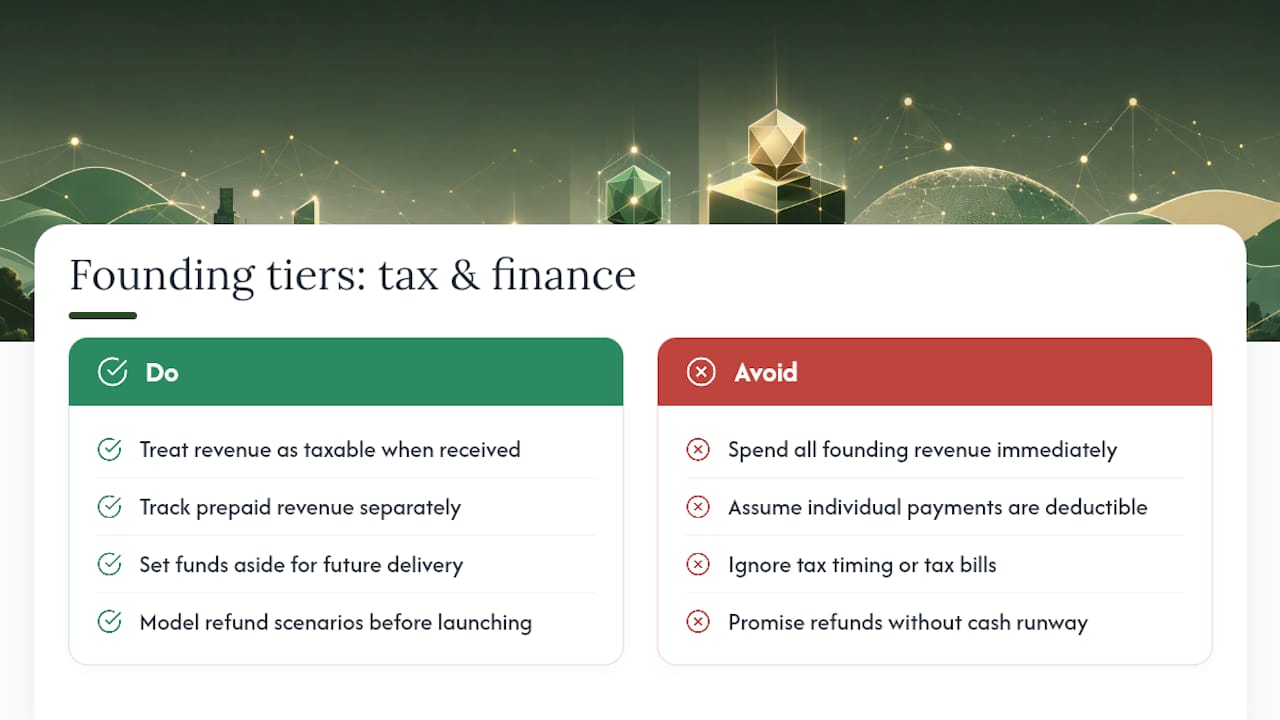
Money collected from founding members before a product or service fully exists carries real financial weight beyond the marketing win. For organizers, that revenue is typically taxable income in the year it's received, not the year the product ships, regardless of how far out the deliverable is. That timing mismatch catches new organizers off guard when a big signup week creates a tax bill before the actual build costs land.
Founders offering annual plans face a similar wrinkle: prepaid revenue often needs to be tracked separately from cash on hand, since a chunk of it represents work still owed to members. Setting aside a portion of founding revenue rather than spending all of it immediately is a basic guardrail against promising more than the runway supports.
For members, a founding-tier subscription paid as an individual is rarely deductible unless it's tied to a business expense, and even then, only the business-use portion typically qualifies. Organizations paying for team memberships should keep receipts and confirm deductibility with a tax preparer rather than assuming a membership fee automatically counts as a write-off.
Refund policies also carry financial exposure. A minimum-cohort refund clause protects members, but organizers need to model what happens to their finances if that clause gets triggered, and whether they can actually return the money without disrupting the business. None of this is exotic accounting. It's the kind of basic cash discipline that separates a founding launch that survives its first year from one that collects money it can't service.
The Real Downsides of Being a Founding Member
Early access comes with early risk, and that risk is worth naming plainly. The product you're paying for might change shape entirely by month three, sometimes into something you like less than what was promised at launch. Feature roadmaps shift, priorities get reordered, and the input you were promised can turn into a suggestion box that never gets acted on.
Pricing locks aren't always as permanent as they sound. A lapsed payment, a missed renewal, or a platform change in ownership can quietly end a "forever rate" that was never protected by anything more than a promise on a landing page. Read the actual terms, not just the pitch.
There's also the risk that the organization or product simply doesn't survive. Founding tiers exist specifically because the thing being built isn't proven yet, and a portion of early-stage ventures never make it past their first year regardless of how enthusiastic the founding cohort was. Recognition and status feel good, but they don't refund a subscription if the platform shuts down.
Finally, founding member communities can turn into unpaid labor if organizers lean too hard on feedback requests without shipping visible progress in return. A founder who spends hours in feedback calls and gets nothing built from their input is right to feel shortchanged, and that resentment spreads fast in a small, connected cohort.
What Most Founding-Tier Advice Gets Wrong
Most guides treat founding member benefits as a pricing trick, discount the product, call people "founders," and move on. That's backward. The discount is the least interesting part of the deal. What actually determines whether a founding cohort turns into loyal, vocal advocates or a batch of quiet cancellations is whether the organizer treats week one as sacred.
I'd argue the single most overrated founding benefit is "influence." Everyone promises it, few structure it. A vague feedback form is not influence. A monthly call where founders watch their suggestion actually ship is influence, and it's rare enough that when it happens, it becomes the thing founders talk about instead of the price they paid.
The most underrated protection is the minimum-cohort refund clause. Organizers skip it because it feels like admitting the launch might fail. It's the opposite: a floor that triggers a refund is what lets early adopters take a real risk on you without betting their money on your unproven execution. If you're building a founding tier and only fix one thing from this article, fix that first-week deliverable. Everything else, the discount, the badge, the event invite, is decoration around whether you actually shipped something real when you said you would.
— Sheldon
Set Up Your Founding Cohort on Harvest Hub
If you're a producer weighing whether to run a founding tier, Harvest Hub gives you the storefront tools to actually deliver on it. Harvest Hub lets you build a digital farm stand with real inventory, verified-profile trust signals, and direct buyer messaging, so founding members see tangible proof of what they signed up for instead of a promise on a page.
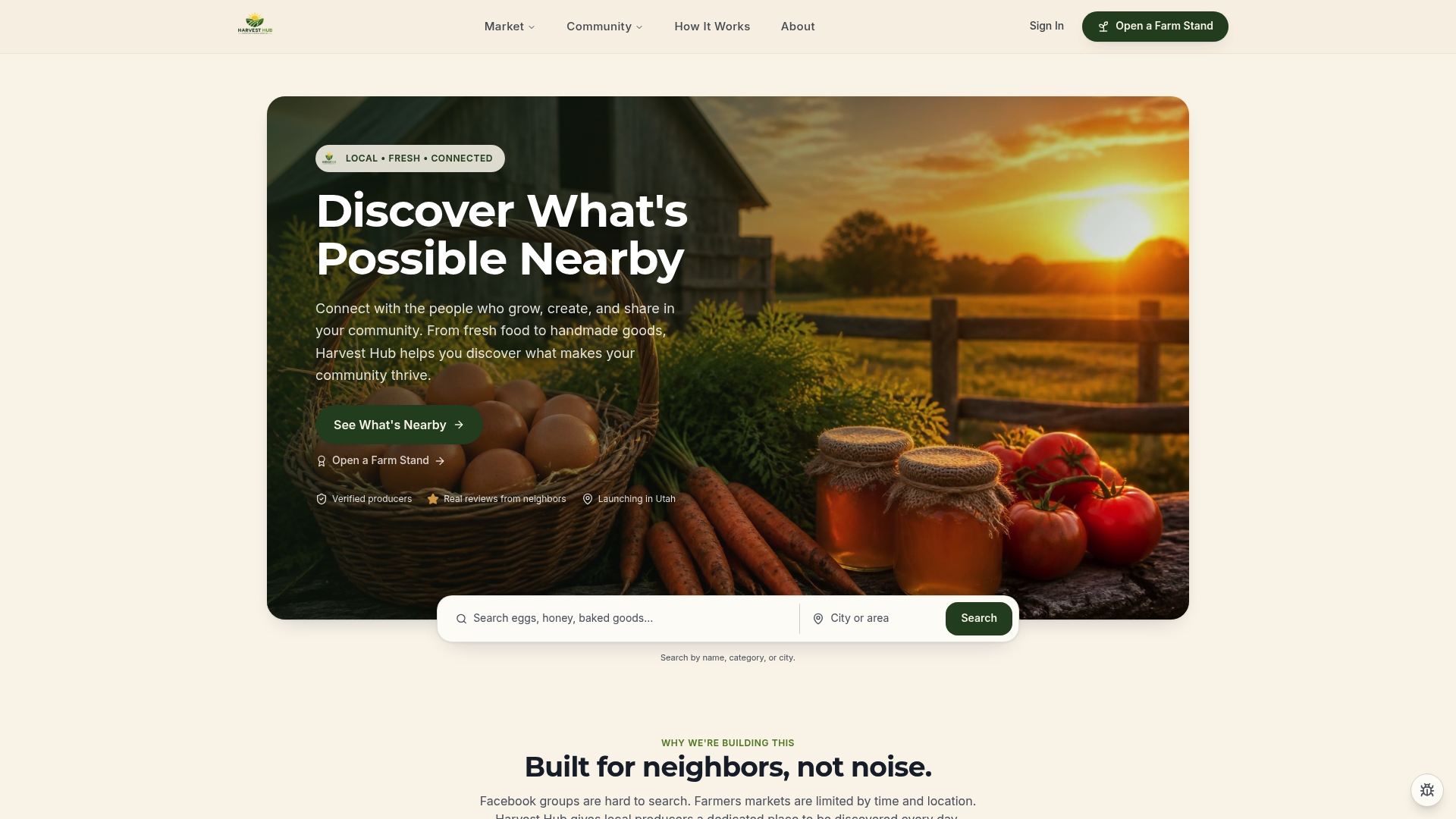
Compare that to running a founding launch through a generic email list or a standalone payment link: you'd still need to build the storefront, the verification system, and the buyer discovery tools from scratch. Harvest Hub's Trust Center handles verification, and the platform's search and map tools put your farm stand in front of local buyers from day one, work you'd otherwise have to solve yourself before your first founding member ever sees a product listing.
Check the Pricing page to see how a Producer Pro subscription fits your founding-rate math, then head to Open a Farm Stand to set up your listing and start your founding cohort this week.
Sources
- Founding Member Launch: How to Get Paid Before You Build Your Membership
- Membership
- Become a Founding Member — Obama Foundation membership benefits page