
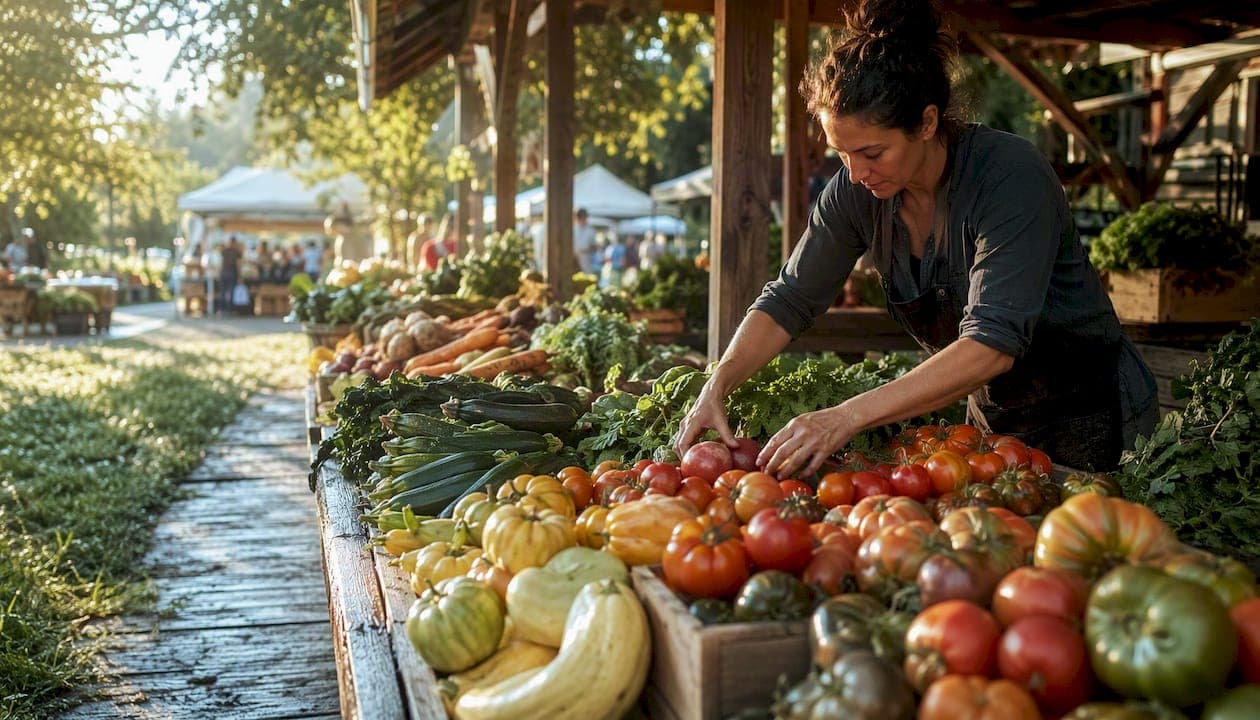
Farm liability insurance pays for legal defense costs, medical payments, and settlements when your farm operation injures a person or damages someone else's property. Start here: confirm your per-occurrence and aggregate limits, ask your agent whether agritourism activities or processed food sales require a separate endorsement, and get a certificate of insurance (COI) before selling at any farmers market or event venue.
Three actions to take right now:
- Verify your limits. Check both your per-occurrence limit and your annual aggregate on your declarations page.
- Confirm agritourism and product coverage. If you host public events or sell jams, cider, or baked goods, your standard policy likely excludes those exposures.
- Request a COI. Most farmers markets and venues require one before you can set up a table or open a gate to visitors.
The University of Missouri Extension and the USDA Risk Management Agency are two of the most reliable U.S. references for farm coverage guidance and federal revenue-protection programs, respectively.
Key Takeaways
Farm liability insurance is the financial foundation that keeps a U.S. farm operation running after a third-party injury or property damage claim, and the right coverage requires confirmed limits, the correct endorsements, and a current COI before every market season.
| Point | Details |
|---|---|
| Confirm your limits | Check both per-occurrence and aggregate limits on your declarations page before each season. |
| Endorsements close the gaps | Agritourism, processed product liability, and pollution coverage require separate endorsements on most standard farm policies. |
| COIs open market doors | Request a certificate of insurance naming each market or venue as an additional insured before you set up. |
| Umbrella adds cost-effective protection | A $1M umbrella above a $1M primary policy is typically cheaper than raising primary limits alone. |
| Review annually | Revenue, activities, and employees change; update your policy every year to match your actual operation. |
Table of Contents
- What farm liability insurance actually covers
- How much liability coverage do you actually need?
- Common exclusions and the endorsements that fill them
- Employer liability and workers' compensation: what farms must do
- When an umbrella policy makes sense for your farm
- Other coverages to consider alongside liability
- What drives farm liability premiums
- How to buy or update your farm liability coverage
- How a liability claim works and how to reduce your exposure
- What the research says about agritourism risk and homeowner policy gaps
- Why liability coverage is the foundation of community farming
- Sources
What farm liability insurance actually covers
A standard farm liability policy covers three core exposures: premises liability, operations liability, and basic product liability for unprocessed produce.
Premises liability applies when a visitor is injured on your property. A customer slips on a wet walkway at your farm stand, or a child trips near a fence during a pick-your-own visit. The policy pays for their medical bills and, if they sue, your legal defense. Operations liability extends that protection off the farm. If your tractor clips another vehicle on a public road during a harvest run, the bodily injury and property damage to the other driver fall under this line.
Product liability in a basic farm policy usually covers unprocessed agricultural products. Sell raw tomatoes and a customer claims a foodborne illness? That claim typically falls within a standard farm policy. Sell canned salsa made from those same tomatoes and the exposure shifts. Processed foods usually require commercial product liability coverage rather than a basic farm endorsement, a distinction Nationwide's farm liability guidance makes explicit.
What a standard policy typically does not cover:
- Agritourism events (corn mazes, hayrides, petting zoos, fall festivals)
- Processed food products (jams, ciders, baked goods, value-added items)
- Pollution events (pesticide drift, fertilizer runoff)
- Employee injuries (those fall under workers' compensation)
- Professional services (consulting, veterinary advice)
Homeowner policies are an even bigger gap. Many small-farm owners assume their homeowner coverage extends to the business, but Nationwide's small-farm guidance is direct: homeowner insurance typically excludes business activities, leaving tools, livestock, and revenue-generating equipment unprotected.
Pro Tip: When a farmers market requires a COI or additional insured listing, ask your agent to add the market organization as an "additional insured" on your policy. This is a standard endorsement request and most carriers process it quickly. The Cornell Small Farms Program notes that liability is required by many markets and that supplemental product or vendor liability is often expected for value-added producers.
How much liability coverage do you actually need?
Understanding the difference between a per-occurrence limit and an aggregate limit is the first step. The per-occurrence limit is the maximum the insurer pays for a single claim. The aggregate limit is the total the insurer will pay across all claims in a policy year. A policy with certain per-incident and total annual limits pays up to the specified amounts per incident and total in a year.
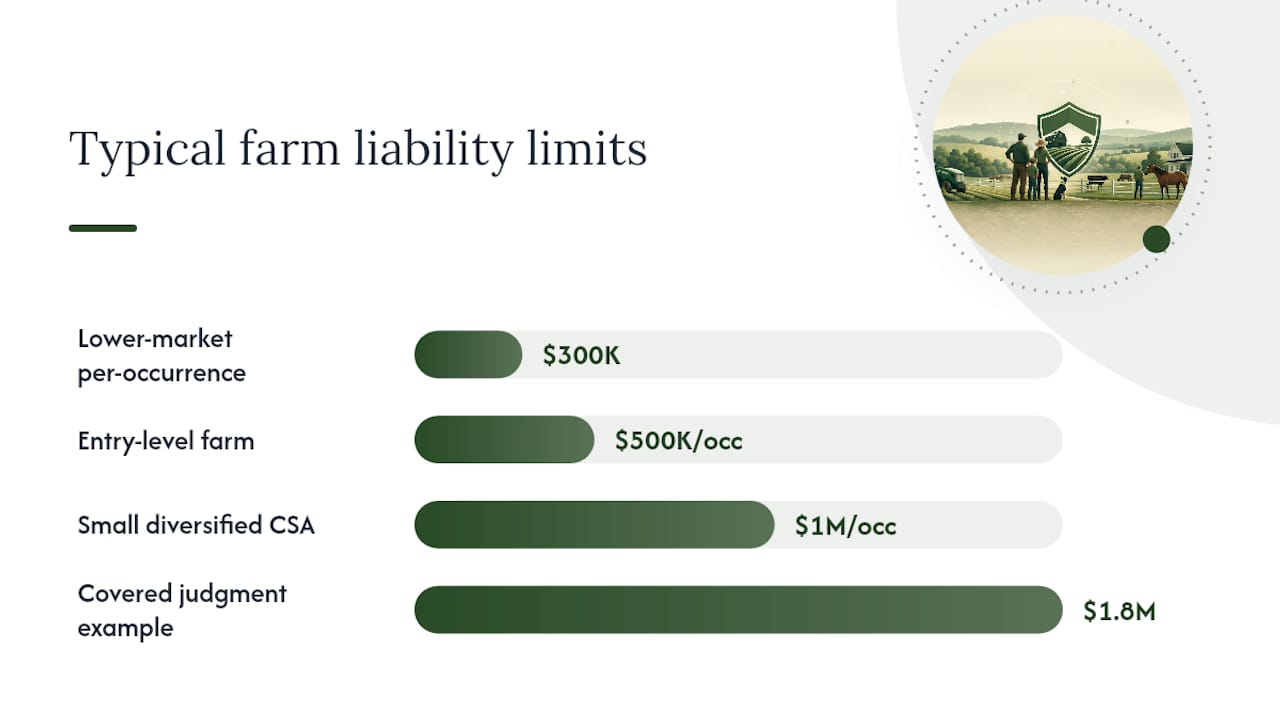
Common market practice for farm liability runs from $300,000 to $1M per occurrence for smaller operations. Farms with significant public traffic, agritourism activities, or high-value personal assets often need more, and an umbrella policy is the most cost-effective way to get there.
| Operation Type | Suggested Baseline | Notes |
|---|---|---|
| Entry-level farm stand (direct sales only) | $500K per occurrence | Meets most market COI requirements |
| Small diversified CSA (home deliveries, on-farm pickup) | $1M per occurrence | Product handling and visitor exposure |
| Mid-size farm with public events or U-pick | $1M + $1M umbrella | Agritourism endorsement also required |
Signals that you need higher limits or an umbrella:
- Significant off-farm vehicle traffic or deliveries
- Regular public visitors (U-pick, farm tours, events)
- High-value personal assets (home equity, savings, equipment)
- Employees or seasonal workers on payroll
- Prior claims or incidents in the last three to five years
A $1M umbrella sits above your primary $1M policy, meaning a $1.8M judgment would be covered: $1M from the primary policy, $800K from the umbrella. Without the umbrella, you pay that $800K gap personally.
Common exclusions and the endorsements that fill them
Most coverage gaps come from exclusions buried in the policy language, not from the insurer acting in bad faith. Carriers exclude certain activities because the risk profile is materially different from standard farm operations.
Frequent exclusions and why they exist:
- Agritourism/entertainment: Corn mazes, hayrides, and petting zoos bring large numbers of non-farm visitors into hazardous environments. Carriers price this separately.
- Processed product liability: Once you cook, ferment, or preserve a product, the contamination risk changes. Standard farm product liability does not follow the product into a jar.
- Pollution: Pesticide drift or fertilizer runoff can affect neighbors, waterways, and third parties. Pollution liability is almost always a separate endorsement.
- Intentional acts: No policy covers deliberate harm.
- Professional services: If you charge for consulting or training, that exposure needs a professional liability policy.
- Certain animal exposures: Equine liability is frequently excluded or sublimited on standard farm policies.
| Endorsement | What It Adds | When You Need It |
|---|---|---|
| Agritourism/agritainment | Covers public events, tours, U-pick, corn mazes | Any time visitors pay or are invited onto the farm |
| Commercial product liability | Covers processed/value-added foods | Jams, ciders, baked goods, any cooked or preserved product |
| Pollution liability | Covers pesticide drift, runoff, chemical spills | Farms using pesticides or fertilizers near neighbors |
| Equine liability | Covers horse-related injuries to riders and handlers | Boarding, trail rides, lessons, horse sales |
| Short-term event endorsement | Covers a single festival or event | Fall festivals, one-time farm dinners, seasonal markets |
When reviewing endorsement language, look for phrases like "agritainment activities as scheduled" or "products-completed operations coverage for processed goods." If those phrases are absent, the coverage is absent.
Short-term event endorsements are worth knowing about. If you host one fall festival per year, buying a short-term event endorsement is often cheaper than adding agritourism coverage to your annual policy. MU Extension guidance confirms that policies can be modified to cover short-term events or seasonal exposure rather than paying year-round for occasional risk.
Employer liability and workers' compensation: what farms must do
General liability covers injuries to third parties. It does not cover your employees. That distinction matters enormously in practice, and confusing the two is one of the most common gaps on farm policies.
When a paid worker is injured on the job, the claim typically falls under workers' compensation, not general liability. Workers' comp pays the employee's medical bills and lost wages regardless of fault. Employer liability coverage (usually included in a workers' comp policy) protects you if an employee sues beyond the workers' comp system.
State requirements vary. Many states require workers' compensation for any paid employee, including seasonal hires. Some states have agricultural exemptions for small farms or family members, but those exemptions have limits and conditions. Verify your state's rules directly with your state workers' compensation agency or a licensed agent before your next hiring season.
Questions to work through with your agent:
- How many full-time employees do you have?
- How many seasonal or part-time workers do you hire at peak?
- Do you use independent contractors? (Misclassification is a real exposure.)
- Do volunteers work on the farm? (Some states treat volunteers as employees for injury purposes.)
- What is your total annual payroll? (Workers' comp premiums are payroll-based.)
- Are any workers under 18? (Minor labor laws add compliance exposure.)
Pro Tip: Document employee training and certifications, especially pesticide applicator certifications. If a worker misapplies a chemical and a neighbor files a claim, your insurer will ask whether the applicator was licensed and trained. A documented training record can be the difference between a covered claim and a denied one.
When an umbrella policy makes sense for your farm
An umbrella policy pays above the limits of your underlying farm liability policy. If a jury awards $2.5M in a catastrophic agritourism injury case, and your primary policy limit is $1M, the umbrella covers the next $1M to $2M of that judgment, depending on the umbrella's own limit.
Umbrella policies typically start at $1M increments and require minimum underlying limits before they attach. Common underwriting requirements include:
- A minimum primary liability limit (often $300K–$500K per occurrence)
- No major claims in the prior three to five years
- Documented safety controls (signage, training records, equipment maintenance logs)
- Employee screening for operations with significant public contact
Two scenarios where an umbrella prevents personal asset loss: A vehicle-trailer accident on a public highway causes serious bodily injury to multiple people. Your primary auto and farm liability policies pay their limits, but the total damages exceed both. The umbrella covers the gap. Alternatively, a visitor at a U-pick operation falls from a ladder and sustains a traumatic brain injury. Medical costs and lost wages alone can exceed $1M before a jury verdict is reached.
Raising primary limits from $1M to $2M often costs more than buying a $1M umbrella on top of a $1M primary policy. The umbrella is usually the more cost-effective path to higher total coverage.
Other coverages to consider alongside liability
Liability is one piece of a complete farm risk plan. These adjacent policies address exposures that general liability does not touch:
- Commercial property insurance: Covers barns, storage buildings, equipment, and inventory against fire, storm, and theft. A standard homeowner policy rarely covers farm structures adequately.
- Equipment breakdown coverage: Pays for mechanical or electrical failure of tractors, refrigeration units, and processing equipment. Particularly important for farms with cold storage or value-added production.
- Commercial auto insurance: Covers farm vehicles used on public roads. Personal auto policies typically exclude commercial use.
- Product liability for processed foods: Separate from general farm product liability; required for any value-added product sold to the public.
- Pollution liability: Covers pesticide drift, fertilizer runoff, and fuel spills. Often sold as a standalone policy or endorsement.
- Cyber/privacy liability: Relevant for farms selling online, collecting customer data, or using subscription CSA management software.
When bundling makes sense: once a farm has permanent structures, employees, and vehicles, bundling coverages under a single farm package policy typically reduces total premium and eliminates coverage gaps between separate policies.
One federal program worth understanding separately: the USDA RMA Micro Farm Program provides whole-farm revenue protection for eligible small farms, with coverage levels available in a range of options on approved revenue. It is a revenue-protection program, not a liability policy. Farms with approved revenue up to a certain threshold in the first year may be eligible. The RMA program and commercial liability coverage serve different purposes and complement each other rather than substitute for one another.
What drives farm liability premiums
Premiums vary widely because underwriters are pricing the specific combination of activities, visitors, products, and employees on your operation. The main cost drivers:
- Payroll and employee count: More workers means higher exposure and higher premium.
- Visitor volume: A farm that hosts 500 visitors per weekend is priced differently than one with no public access.
- Product processing: Value-added products trigger commercial product liability pricing.
- Animal types: Equine operations carry higher premiums than crop-only farms.
- Number of vehicles: Each commercial vehicle adds auto liability exposure.
- Prior claims: A claim in the last three to five years raises your rate or limits your carrier options.
- Location and state laws: Some states have higher litigation rates or mandatory coverage minimums.
- Safety controls: Documented procedures, trained staff, and physical safeguards lower underwriting risk.
For a simple farm stand selling unprocessed produce with no employees and no public events, bundled general liability plus product liability commonly costs roughly $200–$500 per year and typically provides $1M per-occurrence limits. A small diversified farm with employees, processed products, and occasional agritourism events will pay more, often several times that range, depending on payroll and visitor counts. These figures are illustrative and vary by state, carrier, and specific operation.
Pro Tip: Safety investments pay back in two ways: they reduce the chance of a claim, and they signal to underwriters that your operation is well-managed. Documented training programs, posted warning signs, and written food-handling procedures can lower your premium at renewal.
How to buy or update your farm liability coverage
A step-by-step process keeps you from missing exposures when shopping for or renewing a policy.
- Inventory your exposures. List every activity: direct sales, CSA deliveries, agritourism events, processing, employees, vehicles, and animals.
- Document your revenue. Gather your Schedule F (IRS farm income and expenses) or equivalent records. Underwriters use revenue to price product liability and operations coverage.
- List all activities explicitly. Tell your agent about every public-facing activity, including one-time events. Undisclosed activities are the most common reason claims get denied.
- Gather your current declarations page. Know your existing limits, endorsements, and exclusions before the conversation.
- Request COIs for every market or venue. Ask your agent to issue certificates of insurance naming each market or venue as an additional insured.
- Ask about endorsements. Specifically ask: agritourism, processed product liability, pollution, equine, and short-term event coverage.
- Ask about umbrella options. Get a quote for a $1M umbrella alongside your primary policy quote.
- Compare at least two quotes. Coverage terms matter as much as price. Compare the endorsements and exclusions, not just the premium.
- Confirm the policy form. Most farm liability policies are written on an occurrence form, meaning a claim is covered if the incident happened during the policy period, regardless of when it is filed. Confirm this with your agent.
- Review annually. Revenue, activities, and employees change. Review your policy every year before renewal.
Key questions to ask your agent:
- What is my per-occurrence limit and my annual aggregate?
- Are agritourism activities covered, or do I need an endorsement?
- Does product liability cover processed foods, or only unprocessed produce?
- Who is listed as an additional insured, and how do I add a market or venue?
- What is excluded from this policy?
- Is this an occurrence or claims-made form?
The Cornell Small Farms Program recommends that market vendors confirm liability obligations with each market before the season starts, since requirements vary by market and state.
How a liability claim works and how to reduce your exposure
When an incident happens, what you do in the first 24 hours shapes the entire claims process.
Immediate steps after an incident:
- Ensure the injured person gets medical attention.
- Document the scene: photos, video, names and contact information of witnesses.
- Write down exactly what happened while the details are fresh.
- Do not admit fault or make any payment, even informally.
- Notify your insurance agent or carrier the same day, or the next business day at the latest.
- Cooperate fully with your insurer's investigation.
- If you receive a lawsuit or legal notice, forward it to your insurer immediately.
- Consult an attorney if the claim is serious or if you are unsure about your rights.
Risk controls that reduce both claims and coverage denials:
- Post clear warning signs near hazards (uneven terrain, equipment areas, animal enclosures).
- Use written guest waivers for inherently risky activities (trail rides, U-pick ladders, farm tours).
- Train staff on safety procedures and document that training.
- Maintain equipment and keep maintenance logs.
- Follow food safety protocols (proper temperatures, labeling, handling) and document them.
- Keep pesticide application records and ensure applicators are certified.
One legal point worth knowing: intentional acts and illegal activities are not covered by any liability policy. If a claim involves a regulatory violation, such as an unlicensed pesticide application or a food safety violation, your insurer may deny coverage. Documented compliance is your best protection.
Pro Tip: Keep a simple incident log on the farm. Date, time, location, what happened, who was involved, and what immediate action was taken. A log that predates a claim is far more credible than notes reconstructed after the fact.
What the research says about agritourism risk and homeowner policy gaps
The most common coverage surprise for small farms is not a complicated exclusion. It is the assumption that a standard policy covers what it clearly does not.
Agritourism activities like corn mazes, hayrides, and petting zoos introduce materially higher liability exposure and are frequently excluded from standard farm policies unless a specific endorsement or event coverage is purchased. A fall festival that draws several hundred visitors in a weekend changes your underwriting profile entirely. The visitor count, the physical hazards, and the commercial nature of the event all push the risk outside what a standard farm policy is priced to cover.
The homeowner policy gap is equally common. Extension research and carrier guidance consistently show that homeowner insurance excludes business activities, meaning a farm stand operated from a residential property may have no liability coverage at all for customer injuries unless a separate farm or business policy is in place.
The USDA RMA Micro Farm Program addresses a different risk entirely. It does not pay legal defense costs or injury settlements. Treating RMA revenue protection and commercial liability as complementary tools, not substitutes, is the correct framing.
Pro Tip: If you host even one public event per year, ask your agent about a short-term event endorsement before the event date. Buying it after an incident is not an option, and adding it to an annual policy mid-term is often more expensive than planning ahead.
Why liability coverage is the foundation of community farming
Farms that sell directly to their communities, whether at a market table, through a CSA, or at an on-farm event, carry a different kind of responsibility than commodity operations. Your customers are your neighbors. A single uninsured incident can end not just a business but a relationship with the community you built it around.
Clear liability coverage does three things beyond paying claims. It signals to markets, venues, and buyers that you operate professionally. It protects your family's assets from a judgment that could otherwise reach your home equity or savings. And it keeps the farm running after an incident rather than forcing a shutdown while legal costs pile up.
Harvesthub is built around exactly this kind of direct-market farming. Producers who open a farm stand on Harvesthub are connecting with buyers who want to know and trust their source. Verified profiles, real reviews, and transparent listings are the public-facing side of that trust. Proper insurance documentation is the operational foundation underneath it.
Producers listing on Harvesthub can display their farm stand details, event listings, and product offerings to buyers across their community. Pairing that visibility with a current COI and the right endorsements means you are ready for every market, every event, and every customer who walks through your gate. Check the Harvesthub pricing page to see how a producer subscription fits into your overall farm budget alongside your insurance costs.
Sources
These resources are the most reliable starting points for U.S. farm owners researching coverage options, federal programs, and state-specific requirements.
- Farm Liability Insurance | MU Extension
- Farm stands, U-pick and agritourism: do you need liability insurance? — Ramatici Insurance Services
- Micro Farm 2026 | Risk Management Agency
- Farm Stand Insurance: What Coverage You Need — FindHomegrown
This article is general information, not a substitute for advice from a qualified financial advisor. Consult a qualified financial professional about your own circumstances before acting on anything here.